







Mattress Construction, Mattress Choices, Memory Foam & Hybrid Foam
March 2026Are Simba Mattresses Any Good? An Honest 2026 Review
This is an honest assessment of what a Simba mattress is, what is inside it, what buyers actually experience, and what you need to know before spending up to £1,299 or more on a king size. We make mattresses by hand in Manchester and we have strong opinions about what makes a mattress worth buying. We will share those opinions directly, but we will also give you the information to make up your own mind.
In this guide
- What is Simba Sleep?
- The current Simba mattress range
- What is inside a Simba mattress?
- What does a Simba mattress feel like?
- The CMA investigation into Simba’s pricing
- Common Simba mattress problems
- What our community says about Simba mattresses
- Simba’s 10-year guarantee: what it actually covers
- Who does a Simba mattress suit?
- Simba mattress alternatives at every price point
- Head to head: Simba vs handmade pocket sprung
- Our honest verdict
- Frequently asked questions
What is Simba Sleep?
Simba was founded in 2015 and launched its first mattress the following year. The concept was straightforward: a single hybrid mattress, compressed and boxed, sold online without the showroom pressure and commission structures that had defined the traditional bed retail industry. It was not the only brand doing this at the time, but Simba invested heavily in marketing and built brand awareness faster than most of its competitors. By the time the bed-in-a-box category had become mainstream, Simba was the name most people knew.
The business raised over $226 million in funding across multiple rounds from investors, including venture capital firms, private equity backers, and a range of angel investors. That funding fuelled international expansion, product development, and the kind of television and digital advertising that kept the Simba name in front of UK consumers for years. The brand now sells across nine countries in Europe, Asia, and North America.
One thing worth clarifying for anyone who has heard otherwise: Simba has not gone into administration. The brand trades independently as Simba Sleep Limited. In May 2025, Simba announced a retail partnership with Bensons for Beds, which now stocks selected Simba mattresses in over 50 Bensons stores across the UK. This gives shoppers the option to try a Simba mattress in person before buying, which was not previously possible through Simba’s own direct-to-consumer model. The partnership is a distribution arrangement, not a change of ownership.
Where Simba does share something with the bed-in-a-box sector more broadly is a history of regulatory scrutiny over its pricing practices. We will come to that in detail below.
The current Simba mattress range
Simba organises its mattresses into two families: the Hybrid range, which uses synthetic and graphite-infused foam alongside titanium Aerocoil springs, and the Natural Hybrid range, which adds natural materials including British Wool, bamboo, and wool-bamboo blends. Both families are built around Simba’s patented Aerocoil micro spring technology and medium-firm tension throughout.
| Model | Depth | Key upholstery | Approx. king size full price |
|---|---|---|---|
| Hybrid Essential | 20cm | Simbatex foam, no wool | From approx. £499 |
| Hybrid | 25cm | Simbatex foam, no wool | From approx. £699 |
| Hybrid Pro | 28cm | Simbatex foam, British Wool layer | From approx. £1,049 to £1,299 |
| Hybrid Luxe | 31cm | Simbatex foam, 90% British Wool, 10% bamboo | From approx. £1,399 |
| Hybrid Ultra | 34cm | Wool, charcoal bamboo, kapok, latex, coconut fibre | From approx. £1,699 |
Simba runs frequent discounts of between 30% and 50% off its listed prices, meaning the price you actually pay is often considerably lower than the figures above. This discount structure is central to how Simba markets to buyers and was the subject of a formal regulatory investigation, which we cover in its own section below.
What is inside a Simba mattress?
All Simba mattresses are built around the same core concept: conical titanium alloy Aerocoil micro springs positioned in the upper layers of the mattress, above a foam comfort and support system. The conical shape is what distinguishes Simba’s spring design from a traditional pocket spring. Because they taper towards the top, each spring has a variable response: lighter at the point of contact, firmer under deeper compression. Simba holds a global patent on this design and uses it across the entire range.
The upper comfort layers in the entry and mid-range models are built from Simbatex foam, an open-cell, graphite-infused proprietary foam that Simba claims has over five times the airflow of standard memory foam in independent testing. This is a meaningful distinction from standard closed-cell memory foam, which can trap heat. The graphite infusion is designed to dissipate warmth rather than store it. Below the Aerocoil layer and comfort foam sits a deeper support foam base, typically zoned to provide differential support across the hips, shoulders, and lumbar region.
In the Hybrid Pro and above, a layer of British Wool is added above the comfort foam. The Hybrid Luxe uses 90% British Wool with 10% bamboo. The Hybrid Ultra goes further with a more complex natural material combination, including wool, charcoal-infused bamboo, kapok fibres, and a blend of latex and coconut fibre in the support layers. The Natural Hybrid range also includes models branded as Earth, Escape, Apex and Source, each with varying combinations of natural and technical materials.

One construction point worth understanding is that all Simba mattresses are one-sided. The Aerocoil spring system is designed to work in one orientation, with springs positioned in the upper portion of the mattress facing upwards. You cannot flip a Simba mattress to wear it evenly on both faces. Simba recommends rotating the mattress 180 degrees every few months, which redistributes wear across the length of the mattress, but the mattress cannot be used on both sides the way a traditionally two-sided pocket sprung mattress can.
What does a Simba mattress feel like?
Every Simba mattress is rated as medium-firm, which the brand describes as the most universally appropriate tension based on independent sleep research. In practice, the feel is a foam-dominant hybrid: you get the bounce and airflow of springs, but the immediate contact point is foam rather than a natural fibre upholstery layer. This produces a supported but cushioned sensation that is different in character from a traditionally sprung mattress with natural Wool or Cotton upholstery.
The Hybrid and Hybrid Pro are the most commonly reviewed models and are consistently described as comfortable for back and combination sleepers at average body weights. Side sleepers at lighter weights tend to find the medium-firm tension appropriate, though some heavier side sleepers report that the foam compresses more than expected under prolonged pressure at the hip and shoulder. The Hybrid Pro’s Wool layer adds a degree of natural temperature regulation that the entry-level Hybrid lacks.

Motion transfer is one area where Simba receives consistently good reviews, particularly for couples. The Aerocoil micro springs respond individually rather than as a unit, which means movement on one side of the bed is absorbed at the point of impact rather than transmitted across the mattress. This makes the Hybrid Pro especially popular with couples where one partner is a restless sleeper. That said, motion transfer can increase when the mattress is used on a slatted base rather than a solid divan, a point that Simba itself acknowledges.
The CMA investigation into Simba’s pricing
In December 2023, the Competition and Markets Authority opened a formal investigation into Simba Sleep Limited over concerns about two specific practices: misleading price comparisons and pressure-selling through countdown clocks.
The investigation found that Simba had been displaying “was” prices alongside discounted prices in ways that did not accurately reflect genuine prior selling prices. In simple terms, the original higher price that a discount was calculated from had not always been a price at which a significant volume of the mattress was actually sold, meaning the apparent saving was potentially misleading.

The CMA also found that countdown clocks on Simba’s website created a false sense of urgency, implying that offers would expire at a specific time when in practice they did not. The Advertising Standards Authority had previously upheld complaints against Simba on similar grounds in September 2022 and again in March 2024.
By July 2024, Simba had signed formal undertakings with the CMA, committing to: ensure that any “was” price reflects a genuine prior selling price achieved in sufficient volume; make countdown clocks transparent and accurate; and report back to the CMA on compliance by the end of 2024. This is not a minor footnote. It is a formal regulatory finding about the honesty of how a major UK mattress brand presents its prices to shoppers.
We mention this not to single Simba out unfairly. The CMA ran parallel investigations into Emma Sleep and Wowcher on similar grounds, and the investigation was part of a wider crackdown on misleading online selling practices across the sector. But it is relevant context when you see a Simba mattress listed with a large “sale” price reduction and a clock counting down to when the offer ends. The meaning of that clock is now governed by binding legal undertakings.
John Ryan By Design does not run flash sales or countdown promotions. We do not have a “was” price on any product. The price on the product page is the price we charge, every day of the year.
Common Simba mattress problems
The majority of Simba buyers report positive experiences. With over 350,000 five-star reviews across review platforms, the brand has an objectively strong satisfaction record across its customer base. The problems that do appear in feedback tend to follow a consistent pattern, which is worth knowing before you decide.
Firmness perception and weight suitability
The most frequently reported issue among dissatisfied buyers is that the mattress feels softer than expected, particularly for heavier sleepers. Simba describes the entire range as medium-firm, but the foam comfort layers will compress more under heavier body weights. Buyers over approximately 16 to 17 stone often find the Hybrid Original softer than anticipated, and some report that the mattress changes in feel over time as the foam layers settle. The Hybrid Pro and Luxe tend to perform better for heavier sleepers because of their additional depth and spring count, but Simba does not offer body-weight-specific spring tensions the way a traditional pocket sprung manufacturer can.

Off-gassing on unboxing
A meaningful number of Trustpilot reviews mention a strong chemical smell when first unpacking the mattress. This is a characteristic of new foam mattresses generally, not specific to Simba, and most reviewers report it fading within 24 to 48 hours with ventilation. Buyers with chemical sensitivities or respiratory conditions may find this more pronounced, and it is worth allowing the mattress to air in a well-ventilated room before sleeping on it. Simba acknowledges this is a possibility and states it typically resolves within 24 hours.
Motion transfer on slatted bases
Several independent reviewers note that motion transfer increases noticeably when a Simba mattress is used on a slatted bed frame rather than a solid or sprung divan base. The mattress performs best on a solid base where the core is evenly supported. Simba requires that slat gaps do not exceed 70mm, and using the mattress on a frame with wider spacing can also void the warranty.
Sagging and longevity questions
There are reports from longer-term owners about body impressions developing after three to five years of use, though this is less prevalent in Simba feedback than in feedback for all-foam mattresses. Because Simba mattresses are one-sided, the foam comfort layers are only worn from above, and the upper layers will compress over time regardless of rotation. A genuinely two-sided pocket sprung mattress, used on both faces, distributes wear across double the upholstery depth, which is one of the reasons two-sided construction has been the standard for British handmade mattresses for generations.
What our community says about Simba mattresses
Over the years we have had dozens of people come to our Ask the Community forum with questions about their Simba mattresses. These are real buyers who purchased Simba, ran into problems, and came to us looking for answers or alternatives. The questions are published in full on the forum, along with our responses. The themes that come up again and again are worth reading before you spend.
“We bought a Simba foam mattress over a year ago and we are waking up in pain”
One of the most common enquiries we receive is from couples who bought a Simba on the strength of its reviews and found themselves waking with back or hip pain after a few months. In one forum question, a buyer asked whether their metal bed frame was causing the problem. Our answer was that the base was almost certainly not to blame: the more likely explanation is that the Simba’s foam layers hold the body in one position during the night. Memory foam requires heat to mould around you, which is how it conforms to your shape. The consequence is that you are held in position by the foam as it warms, and making micro-adjustments during the night, the kind your body makes naturally on a pocket sprung mattress, becomes more effortful. For anyone with a bad back or pre-existing joint issue, this lack of easy movement during the night can cause significant discomfort.
The other factor is spring tension. A Simba mattress comes in one support level, medium-firm, regardless of the body weights of the people sleeping on it. A person at 9 stone and a person at 15 stone will both receive the same spring. On a traditionally made pocket sprung mattress, the spring wire gauge is chosen specifically based on body weight: a 1.2mm soft spring for lighter sleepers, a 1.4mm medium for average weights, a 1.6mm firm for heavier sleepers. Getting the spring tension wrong is the single most common cause of mattress-related pain in our experience, and it is something the one-size model simply cannot address.
“My teenage son’s Simba makes him sweat more than he might”
In another forum thread, a returning customer, who had an Artisan Naturals herself and loved it, asked for help with her son’s Simba which was running very hot. She had tried a feather topper to no avail and was wondering whether Latex would help. Our honest answer was that nothing on top of the mattress will meaningfully solve a heat problem that originates in the mattress itself. Adding a Latex topper would compound the heat rather than reduce it. The real answer was that the Simba’s Simbatex foam, however well engineered, is a synthetic material that retains more heat than natural Wool, Horsehair, or Mohair. Simba publishes no depth, density, or technical specification for its foam layers, so it is genuinely impossible for us or anyone else to advise on exactly why the heat issue presents as it does for any individual sleeper. The fix, as we told her, is a full pocket sprung mattress with natural fibre upholstery.
“We are currently trialling a Simba but finding it very hot”
A couple trialling a Simba within the return window came to us asking for an alternative at around £700 for a king size. Both were average weights. Our response was straightforward: natural fibres give you the coolest sleep surface, but the entry point for our Artisan range, which carries those natural fibres, was outside their budget at that time. We pointed them towards our Origins Pocket 1500 as the best alternative in their price range, being a two-sided mattress with a Wool layer and a pocket spring unit that could be matched to their body weights properly.
“I found the Simba too soft, too soggy and too hot”
One buyer described their experience memorably in a forum post: they had replaced a firm orthopaedic mattress after 20 years with a Simba and found it “too soft, too soggy and also too hot.” They returned the Simba within the trial period and came to us. This is a pattern that reflects something fundamental about the Simba’s feel: the foam-dominant comfort layer has a characteristic slow sink and slow return that some buyers find pleasant and others find confining. Buyers coming from a traditional spring mattress, especially one on the firmer side, often find the foam feel strange rather than comfortable.
“The Simba Hybrid is way too hard for me and has given me lower back ache”
Counterintuitively, we also hear the opposite complaint. In one forum question, a lighter sleeper at around 8.5 to 9 stone found the Simba Hybrid too firm and was experiencing lower back ache. The explanation, as we gave it, is that a fixed medium-firm mattress is calibrated for average body weights: it will feel too firm for lighter sleepers and potentially too soft for heavier ones. This is the fundamental limitation of a single-firmness model. No amount of proprietary foam technology changes the fact that a mattress which cannot be tension-selected by body weight will not fit everyone who lies on it.
If you have a question about your own Simba experience or are looking for a more specific recommendation based on your weight, sleeping position, and budget, our community forum is free to use. We respond to every question personally.

Simba’s 10-year guarantee: what it actually covers
Every Simba mattress comes with a 10-year guarantee covering manufacturing defects. If the mattress fails due to a fault in materials or construction within that period, Simba will replace it. The guarantee is straightforward in this respect and Simba’s track record on honouring it appears generally positive based on customer feedback.
There are conditions that will invalidate the guarantee:
- Use on a base where slat gaps exceed 70mm
- Use by a sleeper over approximately 18 stone (114kg) per person
- Failure to unpack the mattress within the required period of receiving it
- Any damage from burns, cuts, tears, or liquid staining
- Mould resulting from poor care or inadequate ventilation
- Normal softening of the foam comfort layers, which is classified as expected wear rather than a defect
That last point is worth noting. The gradual softening of foam comfort layers over time is not covered under the guarantee. If the mattress feels noticeably softer after four years than it did when new, that is considered normal wear and tear. The guarantee only triggers if there is a manufacturing defect, not if the foam simply compresses through use at a rate the buyer finds disappointing.
For comparison, at John Ryan By Design our guarantee is issued directly by the small team who built your mattress. We have no administration history, no private equity backing, and no change of ownership since the business began making mattresses in Manchester. If there is a problem, you speak to us directly.
Who does a Simba mattress suit?
A Simba mattress is a reasonable choice for buyers who want a branded, well-reviewed hybrid that arrives boxed, comes with a 200-night trial, and offers a foam-plus-spring combination at a mid-to-premium price. It tends to work well for back and combination sleepers at average body weights, couples where motion transfer is a concern, and buyers who prefer the foam-dominant feel of a contemporary hybrid over the more traditional feel of a fully sprung mattress.
It is less likely to suit buyers who sleep particularly hot and find foam upholstery warm even with graphite infusion, buyers over 17 to 18 stone who need a firmer spring tension than Simba’s fixed medium-firm offers, buyers who want a genuinely two-sided mattress they can use on both faces, or buyers who want to know the exact weight of every upholstery layer in their mattress and what fibres it contains. Simba does not publish GSM specifications for its upholstery layers.
Simba mattress alternatives at every price point
The commercially interesting overlap between Simba and what we make here in Manchester is at the Hybrid Pro level and above, where Simba prices converge with our Origins and entry-level Artisan range. This is where the comparison is worth making most carefully, because the buyer spending £1,049 to £1,299 on a Simba Hybrid Pro king size could, for a similar or slightly higher outlay, be sleeping on a handmade pocket sprung mattress with fully disclosed specifications, a body-weight-specific spring tension, and a genuinely two-sided construction.
Origins Pocket 1500: the entry point for handmade
The Origins Pocket 1500 is priced at £1,050 for a king size. It is built on a 1,500 spun-bond pocket spring unit with 1,550gsm of upholstery, including a 300 gsm wool layer. The spring is available in soft, medium, or firm tension based on your body weight. It is a true two-sided mattress. This is not a like-for-like comparison with the Simba Hybrid in terms of what it feels like: the Origins 1500 is a pocket-sprung mattress with natural fibre upholstery, and the feel is different in character from a foam-topped hybrid. But if your budget is in the region of £900 to £1,200 for a king size, this is what that money buys you from a manufacturer who has been making mattresses in the UK for over 25 years.
| Specification | Origins Pocket 1500 | Simba Hybrid Pro (approx. equiv. price) |
|---|---|---|
| King size price | £1,050 | Approx. £1,049 to £1,299 (discounts common) |
| Construction | Pocket sprung, two-sided | Hybrid foam and spring, one-sided |
| Spring count (king) | 1,500 | Up to 3,800 Aerocoil plus 1,000 base springs |
| Upholstery materials | 300gsm Wool, polyester layers | Simbatex foam, British Wool, Stratos cover |
| Total upholstery GSM published? | Yes, 1,550gsm | No |
| Spring tension options | Soft, medium, firm by body weight | Fixed medium-firm throughout range |
| Can be flipped? | Yes, genuinely two-sided | No, one-sided |
| Trial period | 60 days | 200 nights |
| Made in | Manchester, UK | Designed in UK, made with UK and Portuguese suppliers |
Artisan Naturals: where natural fibre upholstery begins in earnest
At £2,180 for a king size, the Artisan Naturals is our most popular mattress. It is built on 1,600 vanadium-coated calico encased pocket springs and carries 3,950gsm of upholstery across four layers: 1,200gsm of blended British Fleece Wool and Cotton, a hairproof cambric cover, 1,250gsm of rebound polycotton, and 1,500gsm of 100% pure Mohair. It is hand-tufted and two-sided. The spring is available in soft, medium, or firm tension based on your body weight.
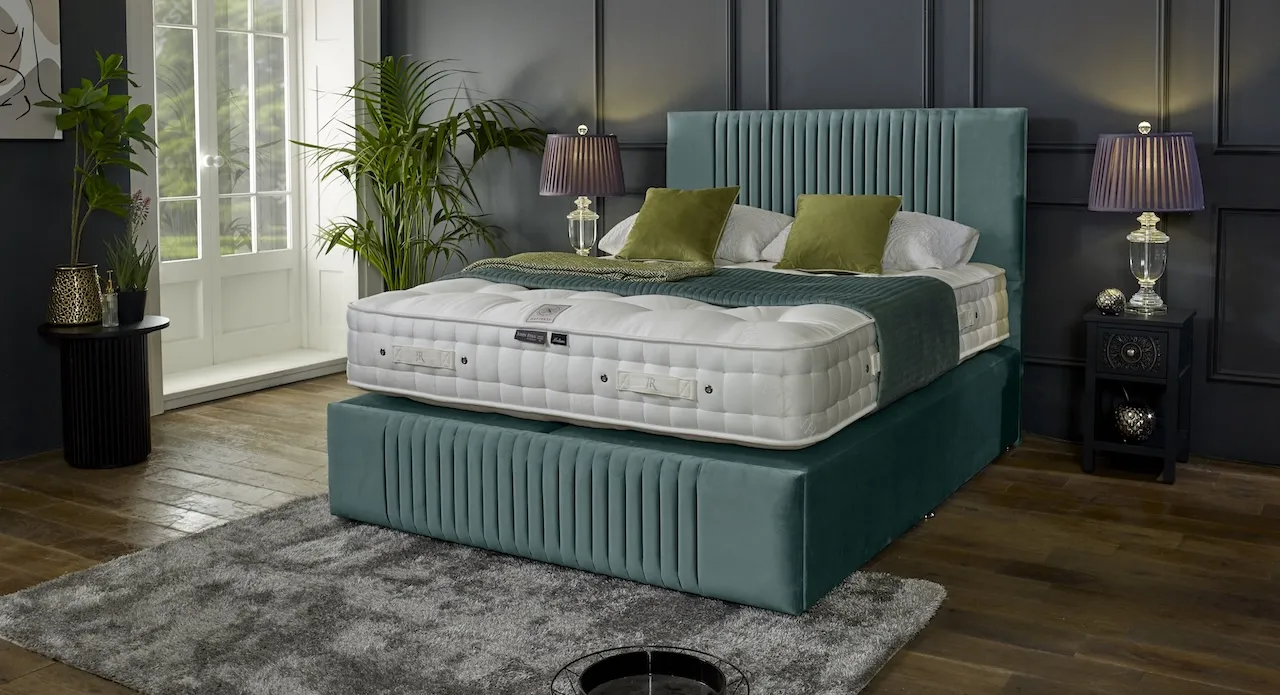
Buyers stepping up from the Simba Hybrid Pro to the Artisan Naturals are making a different kind of purchase. The spring system is calico encased rather than polyester-pocketed, the upholstery is fully natural fibre rather than proprietary foam, and every layer specification is published. There is nothing proprietary about what is inside: it is Wool, Cotton, and Mohair over vanadium-coated pocket springs, made by hand in Manchester.
Artisan Luxury: the premium comparison for the Simba Hybrid Luxe buyer
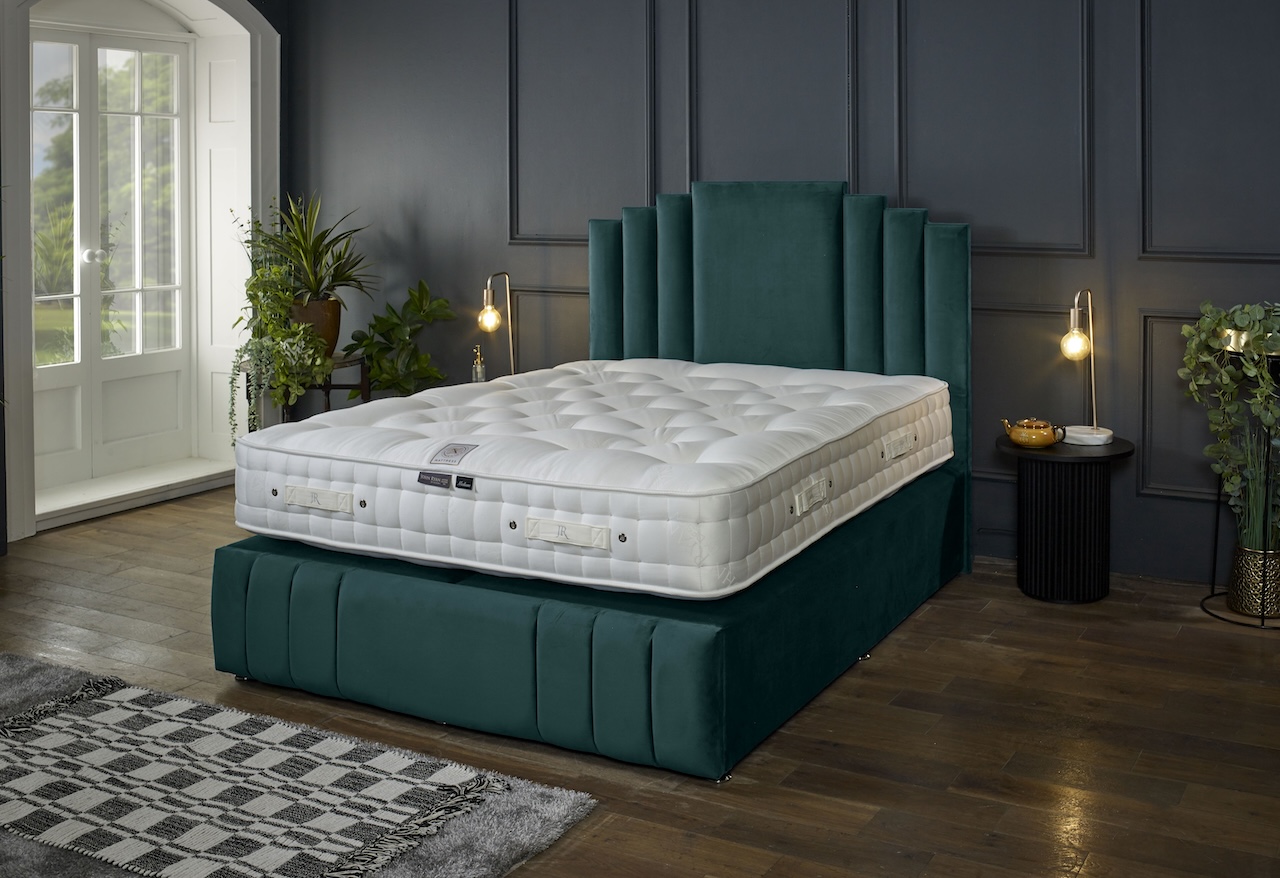
Buyers considering the Simba Hybrid Luxe at approximately £1,399 king size (or the Ultra at approximately £1,699) are spending in a range where the Artisan Luxury at £2,955 king size becomes a meaningful alternative. The Artisan Luxury is built with 1,476 vanadium-coated calico pocket springs across three body-weight tensions and 4,600gsm of 100% natural upholstery: 1,200gsm blended Wool and Cotton, 1,200gsm pure Horsehair, 500gsm pure Wool, 1,200gsm pure Horsetail, and 500gsm pure Wool. Every layer is disclosed by name and weight. There is no proprietary foam, no marketing name for the materials, and no ambiguity about what you are sleeping on.
Head to head: Simba vs handmade pocket sprung
| Feature | Simba (mid to premium range) | John Ryan By Design |
|---|---|---|
| Manufacturing | UK and Portuguese suppliers, rolled and boxed | Handmade in Manchester, not compressed |
| Spring type | Patented Aerocoil titanium micro springs | Vanadium-coated calico encased pocket springs |
| Upholstery materials | Simbatex foam, Wool in upper models | Wool, Cotton, Horsehair, Mohair, Horsetail (by range) |
| GSM published per layer? | No | Yes, every layer |
| Firmness options | Fixed medium-firm across all models | Soft, medium, firm matched to your body weight |
| Two-sided construction? | No, one-sided throughout | Yes, all models genuinely two-sided |
| CMA regulatory history? | Yes, undertakings signed July 2024 | No regulatory history |
| Pricing approach | Frequent discounts from high “was” price | Single transparent price, no sale pricing |
| Trial period | 200 nights | 60 days |
| King size price range | Approx. £499 to £1,699+ (plus discounts) | £890 to £6,500 |
Our honest verdict on Simba mattresses
Simba makes a genuinely good hybrid mattress. The Aerocoil spring technology is distinctive, the build quality is solid, the brand’s track record on customer satisfaction is demonstrably strong, and the Hybrid Pro in particular receives consistently positive long-term reviews from a wide range of sleepers. If you are looking for a foam-topped hybrid with a 200-night trial, strong motion isolation, and reasonable temperature regulation for the money, Simba is a credible choice.
There are things we think a buyer should weigh honestly, though. Every Simba mattress is medium-firm with no option to specify a softer or firmer tension based on your body weight. A 10-stone person and a 17-stone person will receive the same spring tension. This is a fundamental limitation of the bed-in-a-box model that no amount of foam engineering fully resolves. The upholstery specifications are not published in GSM by layer, so there is no transparent way to compare what you are paying for against a competitor. The pricing model, with its heavy reliance on “was” prices and countdown promotions, has been subject to formal regulatory enforcement. And the mattress cannot be used on both sides, which limits its effective working life compared with a genuinely two-sided construction.
If your priorities are a 200-night trial, a well-known brand, a foamy hybrid feel, and the convenience of a boxed delivery, Simba delivers well. If your priorities are published specifications, body-weight-specific spring tension, natural fibre upholstery, transparent pricing, and a two-sided construction that distributes wear across the full depth of the mattress over many years, a handmade pocket sprung mattress is worth the additional investment.
We are happy to help you work out which of our models most closely matches what you are looking for, based on your weight, sleeping position, and budget. You can get in touch with the team directly here, or explore the full range below.
Frequently asked questions about Simba mattresses
Are Simba mattresses any good?
Simba mattresses are well-reviewed hybrid mattresses with a strong customer satisfaction record, particularly for back and combination sleepers at average body weights. The Hybrid Pro is the most commonly recommended model and performs well for couples due to its motion isolation. Common criticisms include a softer-than-expected feel for heavier sleepers, a one-sided construction that limits longevity compared with genuinely two-sided mattresses, and foam comfort layers that do not breathe in the same way as natural fibre upholstery.
Did Simba go into administration?
No. As of March 2026, Simba Sleep Limited trades independently and has not entered administration. In May 2025, Simba announced a retail partnership with Bensons for Beds, which now stocks Simba mattresses in over 50 Bensons stores across the UK. This is a distribution and retail arrangement, not a change of ownership. Simba remains an independent business.
Was Simba investigated by the CMA?
Yes. In December 2023, the Competition and Markets Authority opened a formal investigation into Simba Sleep over concerns about misleading price comparisons and pressure-selling through countdown clocks. The Advertising Standards Authority had also upheld complaints against Simba on similar grounds in 2022 and 2024. By July 2024, Simba had signed binding undertakings with the CMA committing to ensure “was” prices are genuine, countdown clocks are accurate and transparent, and that no false urgency is created around promotions.
What is the difference between Simba Hybrid and Simba Hybrid Pro?
The Hybrid is 25cm deep with Simbatex foam comfort layers and up to 1,900 Aerocoil micro springs in a king size. The Hybrid Pro is 28cm deep with up to 3,800 Aerocoil springs and adds a British Wool layer for improved temperature regulation. The Pro also has a higher base spring count and a Stratos cool-touch cover treatment. Both are medium-firm and one-sided. The Pro is the more popular and better-reviewed model, particularly for couples and side sleepers.
Can a Simba mattress be flipped?
No. Simba mattresses are one-sided: the Aerocoil spring and foam layers are designed to work in one orientation. Simba recommends rotating the mattress 180 degrees every few months to redistribute wear across the length of the mattress, but it cannot be used on both faces. This is different from a traditionally two-sided pocket sprung mattress, where both faces carry full upholstery and the mattress can be flipped to wear evenly on both sides.
What is a good alternative to a Simba Hybrid Pro?
The Origins Pocket 1500 at £1,050 king size is the most direct alternative for buyers who want a handmade pocket sprung mattress at a comparable price point. It uses 1,500 pocket springs with 1,550gsm of upholstery including a Wool layer, is genuinely two-sided, and is available in soft, medium, or firm based on your body weight. The Artisan Naturals at £2,180 king size is the step up, with 3,950gsm of fully natural upholstery across four layers and the same 1,600-spring calico encased vanadium-coated system used across our Artisan range.
Are Simba mattresses good for hot sleepers?
Simba’s Simbatex foam is meaningfully more breathable than standard memory foam, with independent testing showing significantly higher airflow. The Hybrid Pro and above add a Wool layer that improves natural temperature regulation further. That said, the mattresses are still foam-dominant in their comfort layers, and buyers who sleep very warm may find natural fibre upholstery, such as Wool, Horsehair, or Mohair over pocket springs, more effective at drawing moisture and regulating heat through the night.

Dreaming of the perfect nights sleep?
Ask us a question
There are over 6000 questions and answers submitted by you on all questions about mattresses and bed problems. Enter a keyword such as Vi Spring, John Lewis beds, bad back or Memory Foam and see if your question has already been answered.
If you can’t find an answer in knowledge hub, ask a new question. We aim to respond to all questions within one working day.
Newsletter
Enter your email to join our newsletter. We’ll send you occasional news and mattress expertise.