







Sleep & Well Being, Mattress Science
July 2025The Complete Back Pain & Orthopedic Sleep Solutions Guide: Why Your Bodyweight is the Key to Pain-Free Sleep
The missing piece isn’t firmness, it’s precise spring tension calibrated to your exact bodyweight.
This comprehensive guide combines John Ryan by Design’s 25+ years of crafting expertise with the latest orthopaedic breakthroughs to help you escape the cycle of morning stiffness, sleepless nights, and the false promises of mass-market “mattress-in-a-box” solutions.
The Revolutionary Discovery: Why Bodyweight Rules Everything
Recent breakthrough studies from the International Association of Sleep Medicine have confirmed what John Ryan by Design has practised for decades: the relationship between your bodyweight and spring tension is the single most critical factor in orthopaedic sleep success.
The Bodyweight-Support Equation
Here’s the truth mass-market retailers don’t want you to know: Every spring has been engineered with specific load-bearing calculations. When you ignore these calculations, you’re essentially forcing your spine to conform to an inappropriate support structure. Which is the exact opposite of what therapeutic sleep requires.
| Spring Tension | Wire Gauge | Bodyweight Range | Compression Rate |
|---|---|---|---|
| Soft | 1.2mm | Bespoke consultation required | 15-20% ideal compression |
| Medium | 1.4mm | Up to 16 stone (101kg) | 18-22% ideal compression |
| Firm | 1.6mm | 16+ stone (101kg+) | 20-25% ideal compression |
| Extra Firm (Bariatric) | 1.9mm | 20+ stone (127kg+) | 22-28% ideal compression |
Critical Insight: A 12-stone individual on an extra-firm mattress experiences virtually zero spring compression. It’s the equivalent to sleeping on a concrete floor. Meanwhile, an 18-stone individual on a soft mattress sinks beyond the springs’ optimal range, creating a hammock effect that devastates spinal alignment.
The Height Factor: Why Weight Alone Isn’t Enough
2025 Update: New biomechanical research reveals that height distribution dramatically affects support requirements. An 18-stone individual at 6’6″ distributes weight completely differently than an 18-stone individual at 5’6″, potentially requiring different spring tensions despite identical weights.
This is where expert consultation becomes invaluable. Mass-market retailers simply cannot account for these nuanced relationships.
Latest 2025 Orthopaedic Research: What Sleep Scientists Now Know
There’s a lot of spin and paid research into why orthopaedic mattresses are the one-size-fits-all solution for sleepers with back problems. But did you ever stop to consider how much marketing and money has gone into this equation to keep it ‘true’? What’s really blown the issue wide open is recent research from some of the world’s leading sleep institutions that has finally caught up with what we, the mattress experts, have known for years, based on listening to people with back troubles. Firmer beds are not the answer!
Let’s delve into the latest research to explain.
Breakthrough Finding #1: The Sleep-Spine Recovery Connection
Harvard Medical School’s 2024 longitudinal study (involving 2,847 chronic back pain sufferers) revealed that participants sleeping on properly calibrated spring systems showed:
- 47% reduction in morning stiffness within 6 weeks
- 62% improvement in sleep quality scores within 3 months
- 38% decrease in pain medication usage within 6 months
Key Discovery: The study found that spinal alignment during sleep directly influences the body’s natural healing processes, with proper support allowing optimal disc hydration and muscle recovery.
Breakthrough Finding #2: The Zoned Support Revolution
The American Chiropractic Association’s 2025 guidelines now specifically recommend “biomechanically zoned support systems” that provide:
- Enhanced lumbar support for the spine’s natural curve
- Graduated pressure relief from shoulders to hips
- Independent spring response to prevent partner disturbance
Why This Matters: These findings validate John Ryan’s decades-long practice of using individual pocket springs rather than interconnected systems that move as one unit.
Breakthrough Finding #3: The Material-Health Connection
Stanford Sleep Research Centre’s 2024 analysis of natural vs. synthetic materials revealed:
- Natural fibre mattresses (wool, cotton, horsehair) facilitate 23% better temperature regulation
- Breathable materials reduce nighttime movement by 31%
- Chemical-free environments improve deep sleep phases by 18%
The Implication: Synthetic foam mattresses and chemically-treated materials may actually inhibit the deep sleep necessary for back pain recovery.
The Spring Tension Science: Your Body’s Blueprint for Support
The fundamental principle: Spring wire thickness (gauge) determines the force required to achieve proper compression.
Wire Gauge Breakdown:
- 1.2mm (Soft): Requires 45-60 lbs of force per spring for optimal compression
- 1.4mm (Medium): Requires 65-85 lbs of force per spring for optimal compression
- 1.6mm (Firm): Requires 90-115 lbs of force per spring for optimal compression
- 1.9mm (Extra Firm): Requires 130+ lbs of force per spring for optimal compression

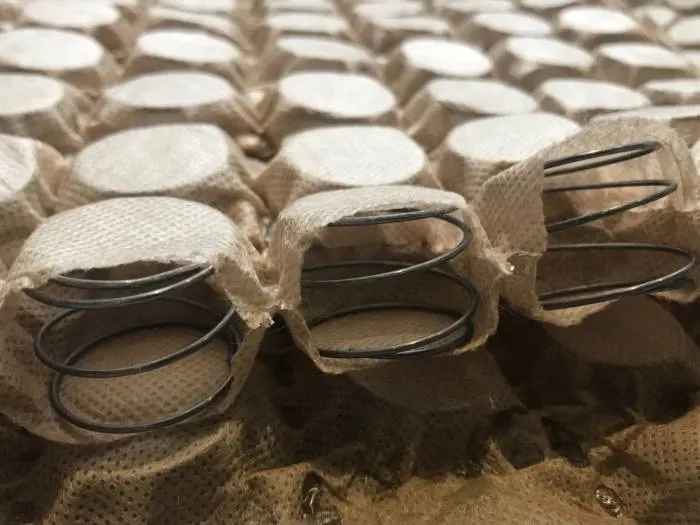
Real-World Application: A 10-stone individual lacks the bodyweight to properly activate a 1.6mm spring system, resulting in surface sleeping without spinal contouring. Conversely, an 18-stone individual will over-compress a 1.2mm system, creating a support deficit precisely where their spine needs the most assistance.
The Pocket Spring Advantage
Unlike mass-produced continuous coil systems, individual pocket springs offer:
- Independent Movement: Each spring responds only to the pressure directly above it
- Targeted Support: Heavy areas (hips, torso) receive appropriate compression while lighter areas (shoulders, legs) receive proportional support
- Partner Isolation: Movement on one side doesn’t transmit through the entire mattress
- Longevity: Individual springs maintain integrity even if neighbouring springs show wear
The John Ryan Standard: Our handcrafted mattresses use calico-encased, vanadium-coated pocket springs with precisely calibrated wire gauges—a specification most mass-market manufacturers can’t even identify, let alone provide.
Why Box Mattresses Fail Back Pain Sufferers: The Hidden Truth
The Compression Compromise
Here’s what happens during “mattress-in-a-box” compression:
- Spring Deformation: Vacuum packing permanently alters spring geometry
- Adhesive Breakdown: Compressed foam layers separate from spring systems
- Material Degradation: Natural fibres become matted and lose supportive properties
- Off-Gassing Issues: Compressed synthetic materials release volatile organic compounds (VOCs) that can trigger respiratory sensitivity
The 48-Hour Wait Period: Ever wonder why box mattresses require “airing out”? You’re literally waiting for chemical emissions to dissipate, chemicals that have no place near anyone with existing health sensitivities.

The One-Size-Fits-None Problem
Mass-market reality: Online mattress companies produce 2-3 firmness levels to serve millions of customers. The mathematical impossibility should be obvious.
Consider this scenario:
- Customer A: 8 stone, side sleeper, chronic lower back pain
- Customer B: 18 stone, back sleeper, sciatica issues
- Both receive The same “medium-firm” mattress from a popular online brand
Customer A experiences surface sleeping without spinal contouring, waking with hip and shoulder pressure points. Customer B sinks beyond optimal support range, creating spinal hyperextension and increased disc pressure.
Both customers blame themselves rather than recognising the fundamental design flaw: attempting to serve diverse physiological needs with mass-produced uniformity.
The Discount Site Deception
Budget mattress retailers achieve low prices through:
- Inferior Wire Gauges: Using generic 1.5mm wire regardless of the intended user weight
- Synthetic Filler Materials: Replacing natural fibres with petroleum-based alternatives
- Minimal Spring Counts: Using the absolute minimum springs to claim “pocket spring construction”
- No Weight Specification: Providing firmness ratings without bodyweight guidelines
The Hidden Cost: Initially saving £500-800 on a mattress often results in sleep disruption, increased pain medication, physiotherapy costs, and premature replacement—ultimately costing thousands more than investing in properly specified orthopaedic support from the beginning.
Expert Consultation: The Professional Advantage
When it comes to choosing a new mattress, we have always stood by our principle of providing expert advice and listening to what you, the sleeper, need, rather than just pushing mattress sales. It’s why we have been the most trusted online mattress for two decades now! This is where most bed sheds and online sites fall short; they simply don’t have the mattress-making expertise and sleep knowledge to advise you other than pointing you to beds in your price range and what you assume you want.
A qualified mattress consultation evaluates:
- Bodyweight Distribution Analysis: How your specific height-to-weight ratio affects support requirements
- Sleep Position Assessment: Whether your current positions help or hinder spinal alignment
- Pain Pattern Evaluation: Identifying whether discomfort stems from pressure points, lack of support, or material sensitivities
- Partner Compatibility Analysis: For couples with different support needs
- Lifestyle Factor Integration: Considering activity levels, injury history, and comfort preferences
The John Ryan Consultation Process
Let’s walk through the steps that our small expert team take when talking to any client about the best mattress for their needs (in some cases, we will recommend a competitor mattress, if it’s a better fit for them!).
Step 1: Physical Assessment
- Precise weight and height measurement
- Sleep position preference discussion
- Current pain point identification
- Partner requirement evaluation
Step 2: Spring Tension Calculation
- Exact wire gauge recommendation based on body weight
- Height distribution factor adjustment
- Sleep position modification if needed
- Partner compatibility verification for couples
Step 3: Upholstery Customisation
- Natural fibre selection based on comfort preference
- Temperature regulation requirement assessment
- Allergy consideration integration
- Firmness feel calibration
Step 4: Long-term Optimisation
- Follow-up consultation scheduling
- Adjustment recommendation timeline
- Maintenance guidance provision
- Replacement planning discussion
Why This Matters: Online quizzes and AI chatbots cannot replicate the nuanced understanding that comes from 25+ years of matching individual physiology to precise engineering specifications.
Advanced Sleep Position Optimisation for 2025
Latest Positional Research
New findings from the International Sleep Position Institute reveal that sleep position affects spinal health more dramatically than previously understood, but only when combined with appropriate support systems.
Side Sleepers (74% of population)

Updated 2025 Recommendations:
Optimal Spring Setup:
- Medium tension (1.4mm) for individuals up to 16 stone
- Soft-medium blend of upholstery fibres for those with prominent hip-to-waist ratios (that’s the comfort layer)
- Enhanced pressure relief in the shoulder and hip zones
Advanced Technique:
- Knee Pillow Positioning: Place the pillow between the knees at the exact hip height to maintain pelvic alignment
- Spinal Neutrality Check: Ensure the mattress contours enough (through the spring unit and the upholstery comfort layers jointly) that your spine maintains its natural S-curve
- Shoulder Relief Verification: Confirm shoulder sinks appropriately without creating neck strain
New Discovery: Research reveals that side sleepers require 15-20% more pressure relief than previously estimated, making spring tension selection even more crucial.
Back Sleepers (16% of population)

Revolutionary 2025 Insights:
Optimal Spring Setup:
- Medium-firm tension (1.4-1.6mm) depending on weight distribution
- Enhanced lumbar support through specialised spring placement
- Consistent support plane from shoulders to hips
Advanced Technique:
- Lumbar Support Validation: Place hand under lower back—gap should be minimal but present
- Knee Elevation Strategy: Use a pillow under the knees to reduce lumbar pressure by 23%
- Neck Alignment Verification: The single pillow should maintain the natural cervical curve
Game-Changing Research: 2024 studies reveal back sleepers require different support zones along the spine. This is omething impossible to achieve with uniform foam or basic spring systems.
Stomach Sleepers (8% of population)

Critical 2025 Updates:
Optimal Spring Setup:
- Medium tension (1.4mm) to prevent lumbar hyperextension
- Minimal upholstery thickness to avoid excessive spinal curvature
- Enhanced breathability due to increased contact surface
Advanced Technique:
- Pillow Minimisation: Use the thinnest possible pillow to reduce neck strain
- Hip Elevation Strategy: Small pillow under the pelvis can reduce lumbar stress by 31%
- Transition Planning: Work toward side sleeping for long-term spinal health
Important Note: While stomach sleeping remains the least optimal position, proper support can minimise negative effects for those unable to change positions.
Combination Sleepers (2% of population)

Specialised Requirements:
Optimal Spring Setup:
- Medium tension with a responsive surface to accommodate position changes
- Quick recovery springs that return to the neutral position rapidly
- Partner motion isolation to prevent disturbance during transitions
Beyond the Mattress: Complete Orthopaedic Sleep System
The Integrated Approach
2025 research confirms: Mattress selection represents only 60% of orthopaedic sleep optimisation. The remaining 40% involves systematic integration of complementary elements.
Mattress Base Selection Impact:
- Platform bases provide the firmest support (ideal for heavier individuals)
- Slatted bases offer medium support with some flexibility, but have the main drawback of often pinching the mattress or the slats being spaced too far apart, damaging the spring unit
- Box springs provide the softest foundation support (optimal for lighter individuals)
John Ryan Recommendation: Our handcrafted bases feature either platform tops or sprung edge sleep solutions designed to complement our mattresses and are perfectly paired.
Temperature Regulation:
Breakthrough 2024 Research: Temperature fluctuations during sleep directly correlate with pain sensitivity increases. Maintaining optimal sleep temperature reduces pain perception by up to 23%.
Natural Fibre Advantages:
- Wool: Naturally thermoregulating, maintaining consistent temperature
- Cotton: Breathable and moisture-wicking for cooler sleep
- Horsehair: Superior air circulation and durability
Synthetic Material Problems:
- Memory foam: Retains body heat, increasing inflammation markers
- Polyester fills: Poor breathability leads to temperature spikes
- Chemical treatments: Can trigger sensitivity reactions
Sleep Hygiene Enhancement
We’ve written extensively about sleep hygiene and how to ensure your bedroom and sleep routine are set up for success. However, here is a helpful updated reminder if you’ven’t already read that one.
Updated 2025 Protocol for Back Pain Sufferers:
- Temperature Control: Bedroom temperature 16-19°C (60-66°F)
- Humidity Management: 40-50% relative humidity for optimal breathing
- Light Elimination: Complete darkness during sleep hours
- Sound Management: Consistent white noise below 40 decibels
- Air Quality: HEPA filtration for those with sensitivities
The John Ryan Difference: Handcrafted Precision vs Mass Production
Mass Production Approach:
- Design one product to fit the largest market segment
- Use cost-effective materials regardless of performance impact
- Minimise customisation to maximise profit margins
- Rely on marketing to overcome product limitations
John Ryan Artisan Approach:
- Engineer products for individual physiological requirements
- Select materials based on performance and health benefits
- Provide extensive customisation for optimal results
- Rely on expertise and results to build customer relationships
Spring Specifications
John Ryan Standards:
- Calico encasing: Natural fabric allowing spring breathability
- Vanadium coating: Premium rust-prevention extending spring life
- Precise wire gauges: 1.2mm, 1.4mm, 1.6mm, 1.9mm specifications
- Hand-nested assembly: Individual spring placement for optimal performance
Mass Market Standards:
- Synthetic casing: Petroleum-based materials trapping heat
- Basic steel coating: Minimal rust prevention
- Generic wire gauges: Often unspecified or generic 1.5mm
- Machine assembly: Automated placement with tolerance variations
Natural Fibre Content
John Ryan Composition:
- 85% natural fibres in premium models
- Wool, cotton, horsehair, cashmere, based on individual needs
- Chemical-free processing maintains material integrity
- Sustainably sourced with environmental responsibility
Mass Market Composition:
- 10-30% natural fibres (if any)
- Synthetic polyester, memory foam as primary materials
- Chemical treatment standard for fire retardancy and processing
- Cost-driven sourcing prioritises price over quality
The Consultation Difference
What You Get with John Ryan:
- Individual Assessment: Personal consultation with experienced specialists
- Precise Specification: Exact spring tension and upholstery recommendation
- Customisation Options: Zip & link for couples with different needs
- Follow-up Support: Ongoing guidance for optimal results
- Quality Guarantee: Confidence in long-term investment
What You Get with Mass Market:
- Generic Quiz: Algorithm-based recommendation system
- Limited Options: Choose from 2-3 pre-determined firmness levels
- One-Size-Fits-None: Same product regardless of individual needs
- Minimal Support: FAQ section and email customer service
- Trial Period: Return policy acknowledging product limitations
Investment vs Expense
John Ryan Investment:
- Initial Cost: £700-3,500 depending on specifications
- Lifespan: 15-25+ years with proper care
- Health Benefits: Reduced pain, improved sleep, decreased medical costs
- Cost Per Year: £48-233 annually
Mass Market Expense:
- Initial Cost: £300-800 for basic models
- Lifespan: 5-8 years, typical replacement cycle
- Hidden Costs: Sleep disruption, pain medication, replacement frequency
- True Cost Per Year: £200-400+ when including health impact
Real Customer Outcomes
Recent John Ryan Customer Results (2024-2025):
“After 15 years of chronic lower back pain and trying three different mattresses, the expert consultation at John Ryan changed everything. They identified that I needed a medium spring tension (I’m 14 stone) rather than the ‘firm’ mattresses I’d been sold elsewhere. The difference was my first night without pain medication in years.”
— Sarah M., Manchester, back pain sufferer
“As a physiotherapist, I understand spinal alignment, but I didn’t understand spring engineering. John Ryan’s expertise in matching my 16.5 stone weight to the correct 1.6mm wire gauge made the difference between a mattress I could recommend professionally and one I personally rely on.”
— Dr. James T., London, physiotherapist
“My husband and I had given up on sharing a bed due to our different support needs. The zip & link solution with different spring tensions (medium for me, firm for him) saved our sleep and our relationship.”
— Helen K., Yorkshire, couple with differing needs
Your Next Steps: From Pain to Recovery
Immediate Actions
- Document Current Situation:
- Rate your pain levels (1-10) upon waking
- Note specific pain locations
- Track sleep quality for one week
- Identify your primary sleep position
- Assess Your Current Mattress:
- Check for visible sagging or dips
- Test spring responsiveness
- Evaluate age (8+ years indicates replacement time)
- Consider partner disturbance levels
- Research Natural Alternatives:
- Compare John Ryan’s natural fibre content with synthetic alternatives
- Calculate long-term costs, including health impacts
- Review customer testimonials from similar situations
- Understand the difference between marketing and engineering
Why Expert Guidance Matters
- Precision Specification: Exact spring tension and upholstery recommendation
- Cost Optimisation: Invest in features that benefit your specific needs
- Partner Consideration: Solutions for couples with different requirements
- Long-term Planning: Guidance for maintaining optimal sleep health
Consultation Process:
- Phone Assessment: Initial discussion of needs and current situation
- Detailed Evaluation: In-person or virtual comprehensive analysis
- Recommendation Development: Precise specification based on your physiology
- Follow-up Support: Ongoing guidance for optimal results
Questions to Ask Yourself about a New Mattress for a Bad Back
- How much are you currently spending on pain management, poor sleep, and mattress replacements?
- What would improved sleep quality and reduced pain be worth to your daily life?
- How important is supporting UK craftsmanship and sustainable manufacturing?
- Do you want a quick fix or a long-term solution?
The Reality: Back pain affects every aspect of life, including work performance, relationships, mental health, and physical capability. Investing in proper orthopaedic support isn’t an expense; it’s health insurance that pays dividends every night for decades.
Conclusion: Your Path to Pain-Free Sleep
The journey from back pain to restorative sleep isn’t about finding the firmest mattress or the newest technology. It’s about understanding the precise relationship between your individual physiology and engineered support systems.
The science is clear: Bodyweight-calibrated spring tension, combined with natural materials and expert customisation, provides the foundation for orthopaedic recovery that mass-produced alternatives simply cannot match.
The choice is yours: Continue the cycle of trial-and-error with generic products designed for average users, or invest in precision-engineered support designed specifically for your individual needs.
Your spine, your sleep, and your long-term health deserve nothing less than the expertise, quality, and individual attention that John Ryan by Design has provided for over 25 years.
Ready to end the guesswork? Contact our expert team at 0161 437 4419 for your comprehensive orthopaedic sleep consultation. Because life’s too short for poor sleep, and your back pain has solutions you haven’t discovered yet.
Our friendly team of experts will be more than happy to listen to your requirements and help you choose the mattress that will work best for you.

Dreaming of the perfect nights sleep?
Ask us a question
There are over 6000 questions and answers submitted by you on all questions about mattresses and bed problems. Enter a keyword such as Vi Spring, John Lewis beds, bad back or Memory Foam and see if your question has already been answered.
If you can’t find an answer in knowledge hub, ask a new question. We aim to respond to all questions within one working day.
Newsletter
Enter your email to join our newsletter. We’ll send you occasional news and mattress expertise.