






Memory Foam Mattresses: Why They Get Hot, Sag and What to Buy Instead
This guide is written for three different readers. If you are considering buying a memory foam mattress for the first time and want to understand what you are actually purchasing, start at what memory foam is and how it is made. If you already own a memory foam mattress and are experiencing heat, sagging, or back pain problems, the sections on why it gets hot, why it sags, and back pain are written for you. If you have specific concerns about chemical safety and off-gassing, go directly to the toxicity section and the certifications explained section that follows it. And if you have already decided memory foam is not right for you and want to know what to buy instead, skip to the alternatives section here.
Jump to:
- What is memory foam and how is it made?
- Why memory foam gets hot
- Does memory foam sag and dip?
- Is memory foam bad for your back?
- Is memory foam toxic? Off-gassing explained
- Certifications explained: CertiPUR-US and OEKO-TEX
- The cooling gel myth
- Memory foam density: what the numbers mean
- Does natural memory foam exist?
- What to buy instead of memory foam
- Frequently asked questions
What is memory foam and how is it made?
Memory foam is a type of polyurethane foam. Polyurethane is a petroleum-derived synthetic polymer, the same family of materials used in car seats, sofas, and industrial insulation. The “memory” in the name refers to its viscoelastic properties: the material softens when it encounters heat and pressure, moulds around the body shape, and then slowly returns to its original form once the pressure is removed.
It was originally developed by NASA in the 1960s for aircraft seat cushioning, where its ability to absorb and distribute impact energy was genuinely useful. The application to mattresses came later, and the properties that made it useful in an aeroplane seat, energy absorption, slow rebound, temperature sensitivity, are the same properties that create the problems most people eventually encounter when sleeping on it every night.
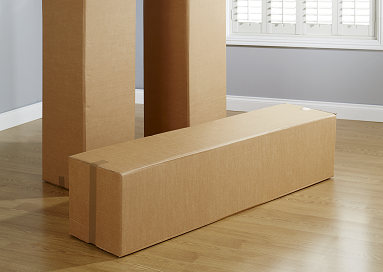
Rolled and boxed memory foam mattresses
The majority of memory foam mattresses sold online in the UK, including brands such as Emma, Simba, Nectar, and similar, arrive compressed and vacuum-sealed into a box or roll. Understanding what that compression process means for the product is worth knowing before you buy.
When a memory foam mattress is compressed for packaging, the foam cells are partially collapsed under the vacuum. Upon unboxing, the foam expands back toward its original dimensions over a period of 24 to 72 hours, sometimes longer for higher-density foams. Most manufacturers advise waiting 24 hours before sleeping on a newly unboxed mattress, though the foam is technically usable before full expansion.
The compression process concentrates off-gassing. A mattress that has been vacuum-sealed has been preventing its VOC emissions from dissipating for the entire period between manufacture and unboxing, which may be weeks or months. When you cut open the packaging, all of that accumulated off-gassing is released at once. This is why the smell from a boxed memory foam mattress can be considerably stronger than that from a traditionally delivered mattress. Unwrapping in a well-ventilated space is more important for a rolled mattress than for any other type.
There is also a question about lower-density foams and repeated compression. High-quality, high-density foam handles the compression and expansion process without meaningful long-term effect. Lower-density foam, compressed multiple times or stored compressed for extended periods, may show slightly accelerated settlement compared to an uncompressed equivalent. This is rarely disclosed in product specifications.
The manufacturing process involves combining polyols and diisocyanates, both petroleum-derived chemicals, under specific temperature and pressure conditions to create the cellular foam structure. The cell structure can be open or closed: open-cell foam allows more air movement and is generally softer but less durable, while closed-cell foam is denser and more supportive but traps heat more aggressively. Neither cell structure eliminates the fundamental heat retention problem, because the issue is not the cell structure alone but the material itself.
The range of quality in memory foam products sold in the UK is enormous and this matters enormously. Cheap imported foams, often from manufacturers who do not meet UK fire regulations, compress far faster and perform far worse than well-made UK foams. British Vita, for example, is one of the UK’s most respected foam manufacturers and their products are genuinely different in density and resilience from the cheapest imported alternatives. When a budget memory foam mattress fails within a year, it is usually because the foam specification was inadequate from the outset, not because memory foam is inherently unsuitable at a better specification level. The better specification level still has all the other problems described below. It just fails more slowly.
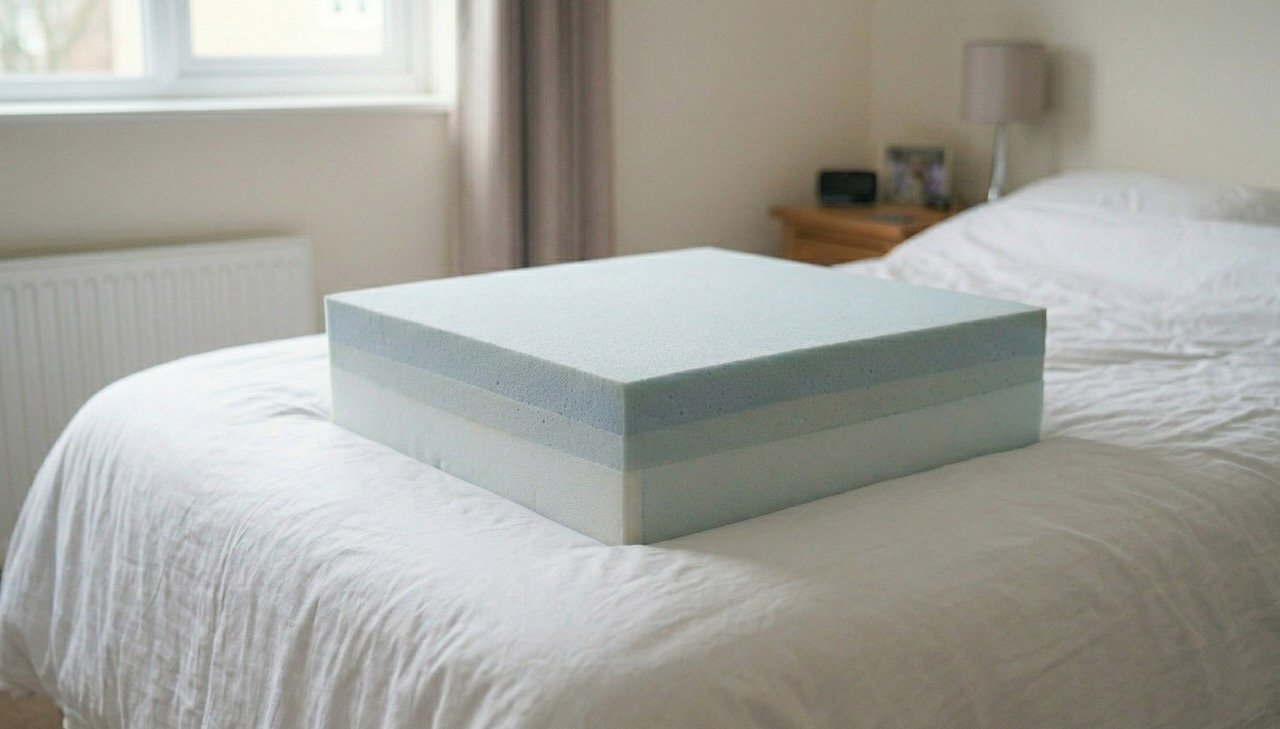
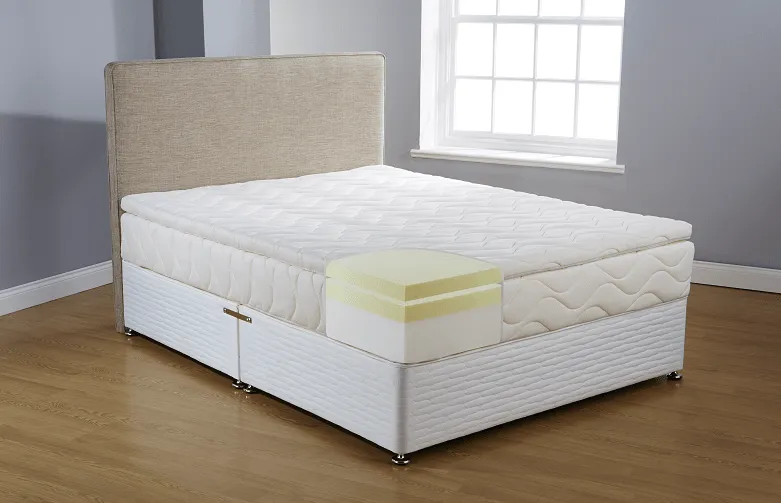
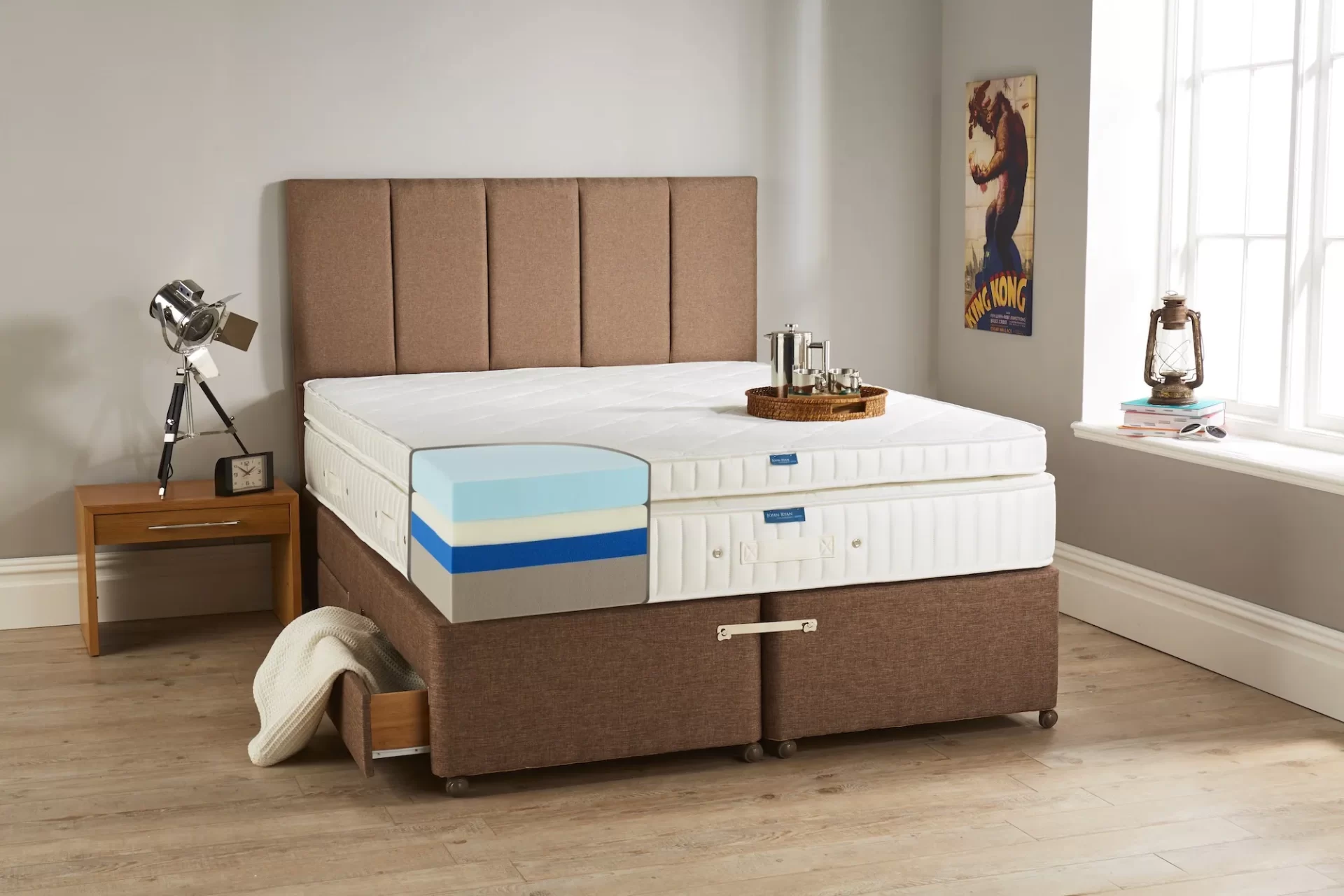
One thing worth understanding before buying is that there is no such thing as a 100% memory foam mattress, even though many are marketed as if there were. Memory foam is always used as a comfort layer over a firmer support foam, typically reflex foam or high-density base foam, because even at its highest density of around 80kg per cubic metre, memory foam is too soft to provide the structural support a mattress needs. A sleeper would simply compress through it entirely.
What you are buying when you buy a “memory foam mattress” is a layer of memory foam on top of a base foam, held together with adhesives (glue), inside a cover. The thickness of the memory foam layer, typically between 2cm and 8cm in most consumer mattresses, determines much of the feel and the heat retention. The base foam beneath it is rarely discussed in marketing material, but is fundamental to how the mattress performs structurally. When a memory foam mattress sags, it is often the base foam that has compressed rather than the memory foam layer itself, which is why the failure can feel different from the gradual softening people expect.
Why memory foam gets hot: the mechanism, not a side effect
The most common complaint we hear about memory foam mattresses, by a significant margin, is heat. People describe waking in the night feeling hot and clammy, being unable to move freely, and finding that no amount of bedding adjustment solves the problem. Understanding why this happens makes it clear why it cannot be fixed without changing the mattress.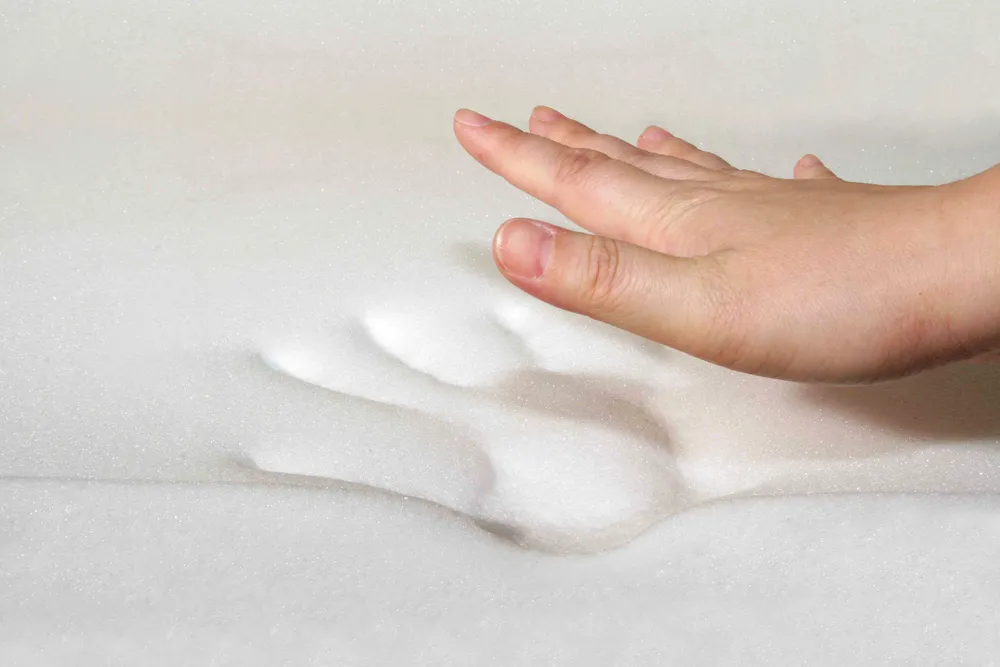
Memory foam requires your body heat to function. The softening and moulding that the material is marketed on depends entirely on the foam warming up under your body. The foam actively draws heat from the body in order to become pliable enough to conform to your shape. Once warm, it holds that heat because the dense cellular structure that creates the contouring effect also prevents air from circulating through the material. The approximately 200ml of moisture your body releases during sleep has nowhere to go. It sits between you and the foam surface, creating the clammy, stuck sensation that wakes people up.
This is not a design flaw that better manufacturing can eliminate. It is the mechanism by which the material works. A memory foam mattress that did not retain heat would not be able to mould to the body. The heat retention and the contouring are the same property. You cannot have one without the other.
The problem is compounded at night because your body temperature naturally rises during certain sleep stages, particularly during REM sleep. On a breathable natural fibre surface, that heat dissipates into the upholstery and away from the body. On a memory foam surface, it is absorbed by the foam and reflected back.
Does memory foam sag and dip? Yes, and here is why
Memory foam compresses faster than almost any other mattress material in common use. The same viscoelastic properties that make it mould to the body also mean it is subject to permanent deformation over time. Each night the foam is compressed under your body weight and warmed by your body heat. Each morning it slowly reforms. Over months and years, the reformation becomes less complete. Body impressions develop that are visible when the mattress is unoccupied. The support the mattress was designed to provide is progressively compromised.
The rate at which this happens depends on foam density. Density is measured in kilograms per cubic metre. A 30kg foam is relatively low density and will compress noticeably faster than a 50kg foam. Many budget memory foam mattresses use 30kg to 40kg foam. The industry-standard warranty threshold for sagging is typically 2.5cm to 3cm of permanent indentation, measured with the mattress unoccupied. By the time a visible hollow has developed to that depth, the mattress has already been providing inadequate support for some time.
The fundamental structural problem is that memory foam mattresses are one-sided. Because the foam support unit is on the base and the comfort layer is on top, the mattress cannot be flipped. All the compression goes into the same surface, in the same areas, every night. A traditional double-sided pocket spring mattress with natural fibre upholstery distributes that compression across two surfaces by being flipped regularly, which is why such mattresses last considerably longer. Memory foam has no equivalent mechanism for evening out wear.
Rotating a memory foam mattress head to foot slows the rate of compression in any one area but does not address the underlying issue. If your mattress has already developed a visible hollow that does not recover overnight, it needs replacing. A topper placed over a sagging memory foam mattress will simply follow the same contour.
Is memory foam bad for your back?
This depends on the stage of ownership. A new memory foam mattress at an adequate density specification can provide reasonable comfort for many sleepers, particularly side sleepers who benefit from the pressure relief at the shoulder and hip. The problem arrives over time as the foam compresses. A memory foam mattress that has developed body impressions is no longer holding the spine in a neutral position. The sleeper sinks into the hollow; the lumbar region is unsupported, and back pain develops or worsens. The mattress may feel soft and comfortable, but comfortable and supportive are not the same thing once the foam has compressed.

The slow response time of memory foam is also relevant for anyone with existing back problems. When you need to change position during the night, which the body does naturally many times to relieve pressure points and maintain circulation, memory foam resists that movement. You have to push yourself out of the body impression before repositioning. This resistance is effortful and can disturb sleep quality even without fully waking you. A responsive material like natural Latex or a calico-encased pocket spring returns immediately when pressure is released, making movement through the night entirely natural.
The Lancet study published in 2003 found that medium-firm mattresses produced significantly better outcomes for chronic back pain than firm ones. Nothing in that research specifically endorses memory foam, and its heat-retention properties are directly counterproductive for anyone with an inflammatory component to their back condition, since elevated sleeping temperature can increase muscular tension around inflamed tissue.
Is memory foam toxic? Off-gassing explained honestly
Off-gassing is the release of volatile organic compounds, VOCs, from materials at room temperature. Memory foam off-gasses because it is made from petrochemical compounds that include formaldehyde, benzene, toluene, and other VOCs. Research published in environmental journals has found individual memory foam samples emitting over 60 different VOC compounds, including known carcinogens. The concentrations are typically low, and the mainstream medical position is that at the levels produced by a standard mattress, the risk is minimal for most healthy adults.
 However, a few qualifications are worth making plainly. The research on long-term, low-level VOC exposure in sleeping environments, where a person spends seven to eight hours per night breathing air centimetres from the foam surface, is less extensive than the reassuring headline statements suggest. Children, who may spend more time on mattresses and whose developing systems are more sensitive to chemical exposure, may face a different risk profile to healthy adults. And the off-gassing does not stop after the first few hours, despite what some manufacturers imply. VOC emissions from memory foam decrease over time but can continue for months or even years after purchase, with the rate influenced by temperature, the higher the bedroom temperature the more the foam off-gasses.
The practical mitigation advice is simple: unwrap a new memory foam mattress in a well-ventilated space and allow it to air for at least 48 hours before sleeping on it. Open windows in the bedroom when possible. Do not place a new foam mattress directly under a child until the initial off-gassing period has passed.
On the question of how long the smell lasts: the initial strong chemical odour from a new memory foam mattress typically dissipates within a few hours to a few days when the room is properly ventilated. Most people find the noticeable smell is gone within 48 to 72 hours of opening the mattress in a ventilated space. However, this refers only to the smell, which is the portion of off-gassing that stimulates the olfactory system. The actual VOC emissions continue at lower, undetectable-by-smell levels for considerably longer, often several weeks to several months, and in some cases up to two years for certain compounds.
The absence of a chemical smell does not mean off-gassing has stopped. It means it has been reduced to below the threshold of human smell detection. For the majority of healthy adults, this distinction is unlikely to matter. For people with respiratory sensitivities, chemical allergies, or children sleeping on the mattress, it is worth knowing that “the smell has gone” and “off-gassing is complete” are not the same thing.
The only way to meaningfully reduce exposure to mattress-related VOCs is to choose a mattress without petroleum-derived foam. A pocket spring mattress with natural fibre upholstery still contains some chemical compounds, primarily in the adhesives used during manufacture and in the fire retardant treatments required by UK regulation. There is no completely chemical-free mattress available in the UK market. But the VOC profile of a natural fibre pocket spring mattress is significantly different from, and lower than, that of a memory foam mattress.

Certifications explained: what CertiPUR-US and OEKO-TEX actually tell you
Two certifications appear repeatedly when researching memory foam mattresses and it is worth understanding precisely what each one does and does not confirm, because the way they are used in marketing overstates what they actually measure.
CertiPUR-US
CertiPUR-US is a certification programme run by a non-profit organisation that tests polyurethane foam for specific chemical thresholds. A CertiPUR-US certified foam has been tested to confirm it is made without ozone-depleting chemicals, without PBDE flame retardants, without mercury, lead, or heavy metals, without formaldehyde, and with VOC emissions below 0.5 parts per million. These are meaningful baseline standards.
However, several important limitations apply. CertiPUR-US certifies the foam only, not the complete mattress. The cover, the fire barrier layer, the adhesives, and any other components of the mattress are outside the scope of the certification. This matters because fire barrier treatments, which all UK mattresses are legally required to have, can themselves be a source of VOC emissions not covered by the foam certification. The programme’s own rules do not permit manufacturers to describe CertiPUR-US certified foam as “non-toxic,” a restriction that is rarely reflected in the marketing language used around it.
CertiPUR-US also does not address the fundamental heat retention and sagging problems with memory foam. A mattress can be fully CertiPUR-US certified and still trap heat against the body, develop body impressions within three years, and be made from low-density foam that performs poorly over time. The certification is a baseline health and safety standard for the foam component, not a measure of sleep quality or product longevity.
OEKO-TEX Standard 100
OEKO-TEX Standard 100 tests textile components for harmful substances, including pesticides, heavy metals, and certain VOCs. A mattress carrying an OEKO-TEX label has had its textile elements (typically the cover fabric and sometimes the upholstery layers) independently tested against this standard. Like CertiPUR-US, the certification applies to the tested components only: an OEKO-TEX certified cover does not mean the foam beneath it meets any particular standard.
The honest summary is this: both certifications are worth looking for because they confirm that specific components have been independently tested against specific thresholds. Neither certification confirms that a mattress is safe in a comprehensive sense, and neither addresses the performance problems that lead most people to move away from memory foam. A pocket spring mattress with natural fibre upholstery does not require either certification because the materials themselves, Wool, Cotton, Cashmere, natural Latex, do not carry the same chemical concerns as petroleum-derived foam. There is no natural fibre equivalent of an off-gassing problem.
The cooling gel myth
Gel-infused memory foam is marketed as the solution to the heat problem. Manufacturers add gel particles or gel layers to the foam and claim they provide a cooler sleep surface. This is true in a very narrow sense: a gel-infused foam feels cooler to the touch initially because the gel conducts heat away from the surface faster than foam alone. After you have been lying on it for 20 to 30 minutes, the gel is at the same temperature as your body, and the surface you are sleeping on is no longer any cooler than standard memory foam.
The underlying problem, that heat retention is a function of the dense cellular structure of the foam and the viscoelastic mechanism that requires heat to operate, is not addressed by adding gel. You are still sleeping on a heat trap. It just takes slightly longer to become uncomfortable. We have never seen a gel-infused memory foam mattress that eliminates the heat complaints entirely for hot sleepers. We have seen plenty that delayed them by twenty minutes.
Memory foam density: what the numbers actually mean
Foam density is measured in kilograms per cubic metre and is the most meaningful single specification when comparing memory foam products. Higher-density foam is heavier, more durable, more supportive, and more expensive. Lower-density foam is lighter, softer initially, compresses faster, and is cheaper to manufacture.
As a practical guide, foam below 40kg per cubic metre is entry level and will show compression within one to three years. Foam between 40kg and 50kg is mid-range and performs adequately for three to five years with care. Foam above 50kg is high quality and can perform well for five or more years. Many budget online mattress brands use 30kg to 35kg foam behind attractive marketing. The specification is often listed in product descriptions, but not prominently: always look for the density figure specifically.
There is a practical budget conclusion that follows from all of this. Memory foam as a material only makes commercial sense as a mattress choice when the budget is genuinely constrained, broadly speaking, below £400 for a king-size. At that price point, the alternatives in natural fibre and pocket spring construction are not realistically accessible, and a decent-density memory foam mattress is a reasonable stopgap.
Spending significantly more than that on a pure memory foam mattress is difficult to justify, because the price gap between a mid-range foam mattress and an entry-level natural fibre pocket spring mattress is now narrow enough that the latter represents meaningfully better long-term value. A natural fibre pocket spring mattress at £890 king size will outlast, outperform in temperature regulation, and hold its support characteristics longer than a memory foam mattress at £600 or even £800. When you factor in the likelihood of needing to replace the foam mattress within five to seven years, the apparent saving evaporates. We say this as manufacturers who would benefit from you spending more, which is why we are comfortable saying it plainly.
ILD (Indentation Load Deflection) is the other specification sometimes quoted. This measures firmness: how many pounds of force are required to compress the foam by 25%. A low ILD means softer foam, a high ILD means firmer. ILD and density are different measurements. A low-density, high-ILD foam can feel firm but still compress permanently faster than a high-density equivalent.
| Foam Density (Memory, Hybrid or Latex) | Feel/Tension |
|---|---|
| 30kg | Ultra Soft |
| 40kg | Soft |
| 50kg | Medium |
| 60kg | Medium |
| 70kg | Firm |
| 80kg | Ultra Firm |
Does natural memory foam exist?
No. This is a marketing claim that circulates regularly and it is not accurate. Memory foam is an entirely synthetic petrochemical product. There is no natural version of it. The only genuinely natural foam used in mattress construction is 100% natural Latex, which is made from the sap of rubber trees and has entirely different properties from memory foam.
Some manufacturers use the phrase “natural memory foam” or “plant-based memory foam” to describe products where a small percentage of the petrochemical content has been replaced with plant-derived oils. These are still predominantly synthetic foam products. The plant-based content, typically between 5% and 20%, does not meaningfully change the heat retention, off-gassing, or compression characteristics of the material. It changes the marketing copy considerably more than it changes the mattress.
What to buy instead of memory foam
The most common reason people contact us is that they are moving away from memory foam and want to know what a genuinely better alternative looks like. Here are the options we recommend, in order of what they address.
If the heat is the main problem: natural Latex or natural fibre pocket spring
Natural Latex is the most direct functional alternative for anyone who likes the contouring, pressure-relieving quality of memory foam but cannot tolerate the heat. It responds to pressure rather than heat, springing back immediately when pressure is released rather than slowly reforming. It is naturally breathable through an open-cell structure. It does not require your body heat to function. It is also hypoallergenic, resistant to dust mites, and significantly more durable than foam.
A natural fibre pocket spring mattress addresses the heat problem differently. The upholstery layers of Wool, Cotton, Cashmere, and Mohair are hygroscopic: they absorb moisture vapour and release it away from the sleep surface rather than trapping it. The pocket springs allow air to move through the mattress structure. The result is a consistently cooler, drier sleeping environment than any foam mattress can provide.
If the sagging is the main problem: double-sided pocket spring
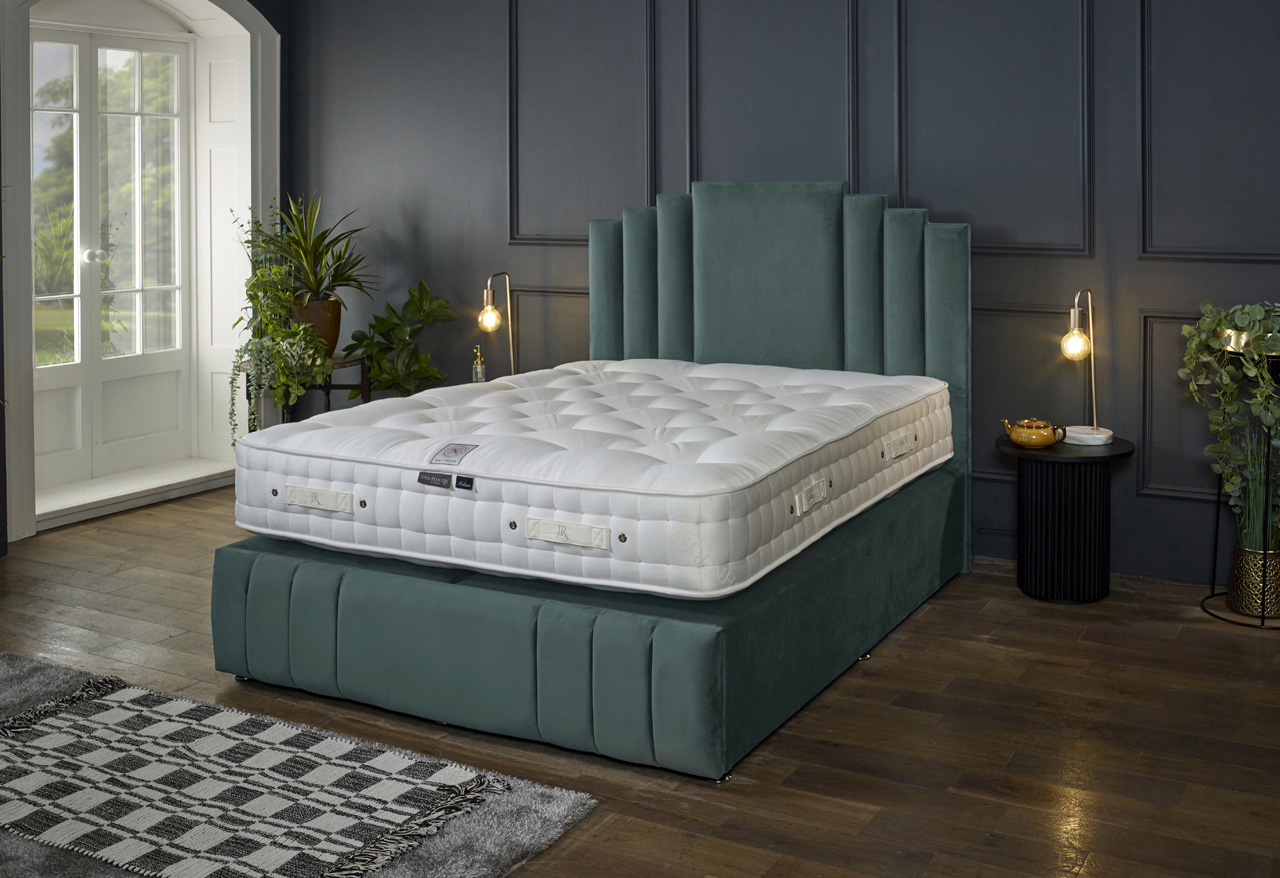
A double-sided mattress distributes compression across both surfaces by being flipped regularly. This is the single most effective structural solution to the sagging problem. Our entire range is double-sided for this reason. A well-made double-sided pocket spring mattress with quality natural fibre upholstery, properly cared for, should last eight to twelve years. A one-sided memory foam mattress at a good density specification typically shows meaningful compression within five to seven years and cannot be corrected by flipping because there is nothing to flip to.
If back pain is the main problem: correct spring tension and medium-firm upholstery
The spring tension should be matched to your bodyweight. A 1.4mm wire gauge spring suits sleepers up to approximately 16 stone. A 1.6mm gauge suits those above. The comfort layers should be in a medium to medium-firm configuration. This combination, weight-matched spring support with responsive natural fibre upholstery, is what the clinical evidence on back pain and sleep consistently describes as most effective. It cannot be replicated by adding a topper to a problematic foam mattress.
Our specific recommendations
For anyone moving from memory foam at a moderate budget, the Origins Natural Comfort (king size £1,300) is the starting point. 1,000 calico pocket springs, 65% natural fibre upholstery including Wool, Silk and Cashmere, double-sided, available in medium and firm tensions. The temperature difference compared to memory foam is noticeable from the first night.
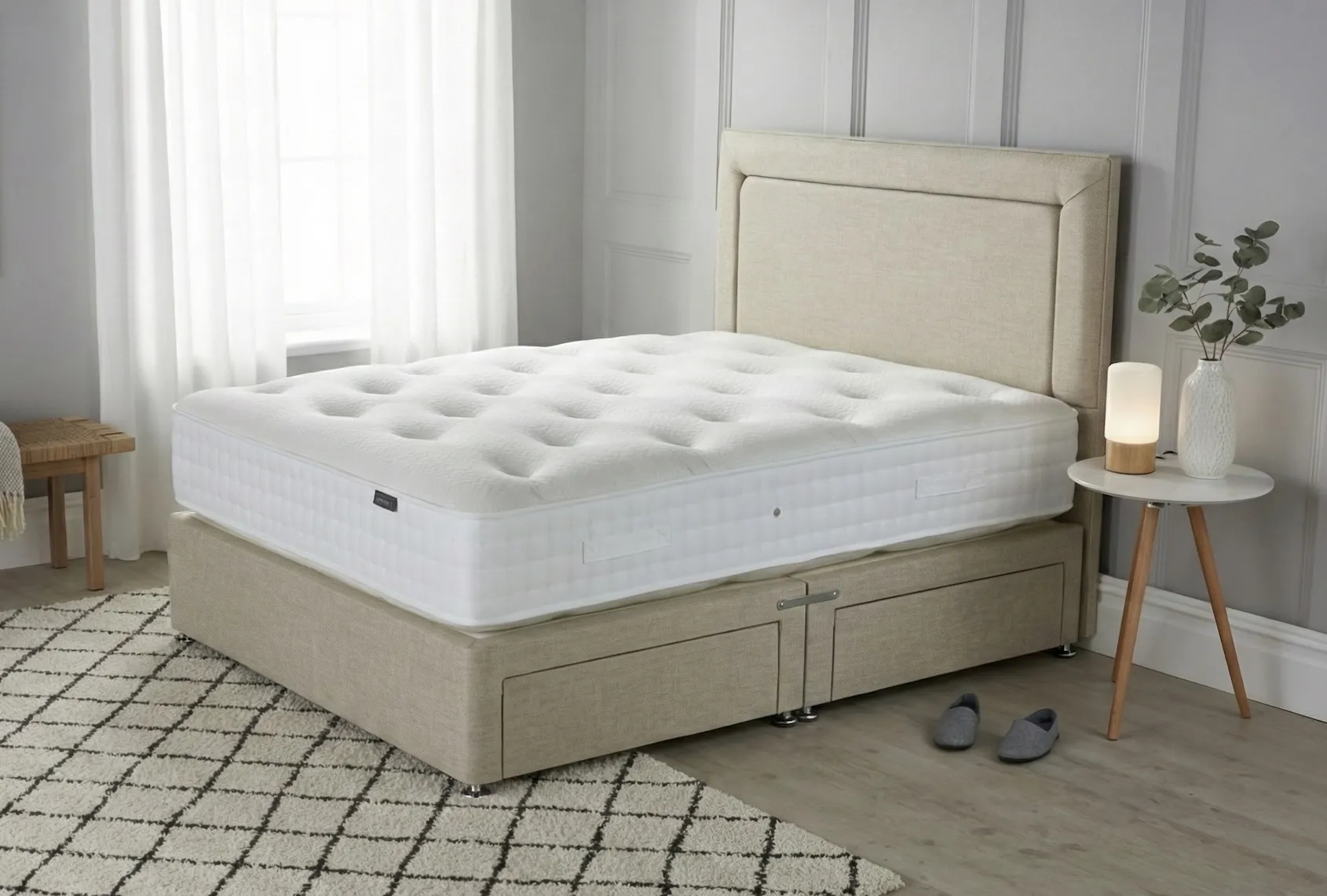
For anyone who wants a higher spring count and more upholstery depth, the Artisan Naturals (king size £2,180) is our most recommended model for people coming from memory foam. 1,600 calico-encased vanadium-coated pocket springs, 85% natural fibre upholstery including Blended British Fleece Wool, Cotton and Mohair, double-sided with hand side stitching, ten-year guarantee. Split tensions available at no additional charge for couples.
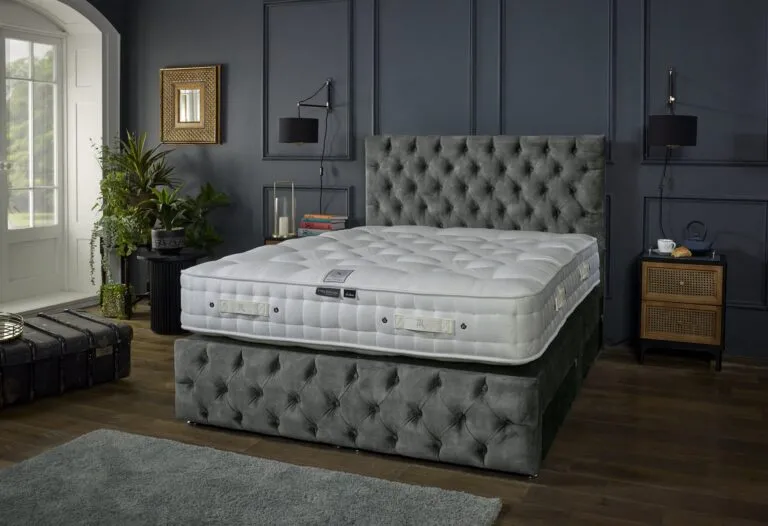
For anyone who specifically wants the contouring quality of foam but in a natural material, the Origins Latex Comfort (king size £1,520) uses 100% natural Dunlop Latex comfort layers over a pocket spring unit. The feel is responsive and pressure-relieving in a way memory foam people often recognise immediately, without the heat retention or the off-gassing.
If you want to talk through which option is right for your weight, sleeping position, and what you have been experiencing on your current mattress, call us on 0161 437 4419. We have had this conversation with thousands of people and the answer is rarely complicated once we understand the situation.
Browse the full John Ryan mattress range.
Frequently asked questions about memory foam mattresses
What is memory foam made of?
Memory foam is made from polyurethane, a petroleum-derived synthetic polymer. The production process combines polyols and diisocyanates, both petrochemical compounds, under controlled conditions to create a viscoelastic foam. The material is the same family of chemistry used in car seats, sofa cushioning, and insulation products. There is no natural version of memory foam: any product marketed as “natural memory foam” or “plant-based memory foam” is still predominantly synthetic, with a small percentage of petrochemical content replaced by plant-derived oils.
Why does memory foam get so hot?
Because heat retention is the mechanism by which memory foam functions, not a side effect. Memory foam softens in response to body heat in order to mould around the body. It draws warmth from the sleeper, holds it within the dense cellular structure, and reflects it back. The same property that creates the contouring effect prevents heat from dissipating. This cannot be fixed with a different cover, a cooling gel layer, or a mattress protector. The only effective solution is a different type of mattress.
How long does a memory foam mattress last?
A high-density memory foam mattress (50kg per cubic metre or above) at a good specification should perform adequately for five to seven years. Mid-range density foam (40kg to 50kg) typically shows meaningful compression within three to five years. Low-density foam (below 40kg), which is common in budget online mattresses, can show significant body impressions within one to two years. Because memory foam mattresses are one-sided and cannot be flipped, all compression is concentrated on the same surface throughout the life of the mattress.
Can a memory foam mattress cause back pain?
Yes, particularly once it has developed body impressions. A new memory foam mattress at an adequate density can provide reasonable short-term comfort for many sleepers. As the foam compresses over time, body impressions develop that hold the spine in a compromised position rather than a neutral one. The lumbar region loses support. Back pain develops or worsens. The mattress may still feel soft and comfortable, but comfort and support are different things once the foam has permanently compressed. If your back pain developed or worsened after buying a foam mattress, the timeline of that change is usually informative.
Is memory foam toxic?
Memory foam releases volatile organic compounds (VOCs), including formaldehyde, benzene, and toluene. Research has found individual samples emitting over 60 different VOC compounds. The mainstream medical position is that at typical bedroom concentrations, the risk to healthy adults is minimal. However, VOC emissions continue for months to years after purchase, not just the first few hours. Children may face a different risk profile.
The specific compounds most frequently cited in health and safety discussions about memory foam are worth naming directly, because they are what people searching this topic are looking for. Toluene diisocyanate (TDI) is used in the production process and is a known respiratory irritant and potential carcinogen at occupational exposure levels, though residual levels in finished foam are typically very low. Methylene chloride, used as a blowing agent in some foam manufacturing processes, is classified as a probable human carcinogen by the US Environmental Protection Agency. Dimethylformamide is associated with liver damage at sustained exposure levels. Vinylidene chloride and acetone are also present in some foam formulations.
The key qualification in each case is that the levels present in a finished mattress are far lower than the occupational exposure thresholds at which harm has been demonstrated. Whether years of low-level nightly exposure in an enclosed bedroom represents a meaningful cumulative risk is a question the research has not yet definitively answered, particularly for children. This is not a reason to panic, but it is a reason to take the “minimal risk” framing with appropriate scepticism rather than accepting it as settled.
The practical mitigation is to air the mattress for at least 48 hours in a ventilated space before use. The only meaningful way to reduce foam-related VOC exposure is to choose a mattress without petroleum-derived foam content.
Does cooling gel memory foam actually sleep cooler?
Initially, yes. Gel conducts heat away from the surface faster than foam alone, so a gel-infused mattress feels cooler to the touch. After 20 to 30 minutes of contact with the body, the gel reaches body temperature and provides no additional cooling benefit. The underlying heat retention mechanism of the foam is unchanged. Cooling gel improves the first few minutes of lying down, not the quality of sleep through the night.
What is the best alternative to a memory foam mattress?
For most people moving away from memory foam, a natural fibre pocket spring mattress in the correct spring tension for their bodyweight is the most significant improvement. Natural fibre upholstery (Wool, Cotton, Cashmere, Mohair) actively manages moisture and temperature rather than retaining heat. Pocket springs provide responsive support that moves with the body rather than holding it in one position. The mattress should be double-sided so it can be flipped, distributing compression evenly and extending useful life considerably beyond a one-sided foam alternative. For those who specifically want the pressure-relieving quality of foam in a natural material, 100% natural Latex is the closest equivalent without the heat retention or off-gassing.
Why do memory foam mattresses sag?
Memory foam is viscoelastic: it compresses under heat and pressure and slowly reforms. Over time, the nightly cycle of compression and reformation is not perfectly reversible. The foam develops permanent body impressions, particularly in the areas of highest pressure, typically the hip and shoulder regions. Because memory foam mattresses are one-sided and cannot be flipped, these impressions accumulate on the same surface throughout the mattress’s life. Higher-density foam sags more slowly, but all memory foam eventually develops permanent compression. The industry-standard warranty threshold is typically 2.5cm to 3cm of permanent indentation, but meaningful support loss occurs before the hollow reaches that visible depth.
Still not sure? Talk to someone who actually makes mattresses
We have been making pocket spring mattresses with natural fibres here in Manchester for over 25 years. In that time, we have spoken with thousands of people who are either trying to make sense of a memory foam purchase that has not worked out or who are trying to avoid making one in the first place. We do not sell memory foam. We have no commercial reason to steer you toward it or away from it other than the fact that we genuinely believe there are better options for most sleepers, and the evidence supports that view.
If you have read this guide and still have questions specific to your situation, whether that is your bodyweight, your sleeping position, a back complaint, a partner with different preferences, or a budget you are working within, our team is available to talk it through with you directly. There are no scripts, no upselling, and no pressure. If the honest answer to your question is that a mattress we do not sell is better suited to your needs, we will tell you that.
Call us on 0161 437 4419. We are available Monday to Friday 9am to 5pm and weekends 10am to 4pm. Alternatively, get in touch via the website and we will come back to you within one working day.
Dreaming of the perfect nights sleep?
Ask us a question
There are over 6000 questions and answers submitted by you on all questions about mattresses and bed problems. Enter a keyword such as Vi Spring, John Lewis beds, bad back or Memory Foam and see if your question has already been answered.
If you can’t find an answer in knowledge hub, ask a new question. We aim to respond to all questions within one working day.
Newsletter
Enter your email to join our newsletter. We’ll send you occasional news and mattress expertise.