


Mattress Care
October 2026New Mattress Uncomfortable? How Long It Takes to Adjust
Waiting for your new mattress to arrive is exciting, especially if you’ve spent weeks doing your research and taking advice. Then the first night comes and it feels nothing like you expected. Too hard, too high, a bit odd under the hips. So have you made an expensive mistake?
Probably not. Most of the “this isn’t right” calls we take in the first fortnight settle down on their own by week four or five. We’ll walk you through why, how to tell a mattress that’s still breaking in from one that’s wrong for you, and the sleep habits that help along the way.

- How long does it take to get used to a new mattress?
- What happens when you break in a new mattress?
- Why does my new mattress feel uncomfortable?
- New mattress too firm or too hard?
- What can you do while it breaks in?
- Have I picked the wrong mattress?
- Making the most of your 60 day guarantee
- My new mattress smells
- When should I turn my new mattress?
- My new mattress has developed ridges
- My new mattress is much thicker than expected
- New mattress FAQs
How long does it take to get used to a new mattress?
Our answer is around four to five weeks. Some of you will feel at home within a few nights, others need the full month, and very few people need longer than that.
Think of it like a new pair of good leather shoes. The first week they pinch in places, then one morning you realise you haven’t thought about them for days. A couple of nights is nowhere near long enough to work out whether a mattress is right for you, so we’d always ask you to give it at least 30 nights before you make up your mind.
We know ourselves that once you get your new bed, you’re eager for the most amazing night’s sleep, but even I have had to wait a week or two to know if our new mattress was suitable, even with my expertise!
Two things are adjusting at the same time. Your mattress is settling, and your body is getting used to being supported properly. If your old mattress was sagging, you’ve spent years sleeping in a dip, and a supportive new mattress can feel firm or even leave you a touch stiff for the first week or so.
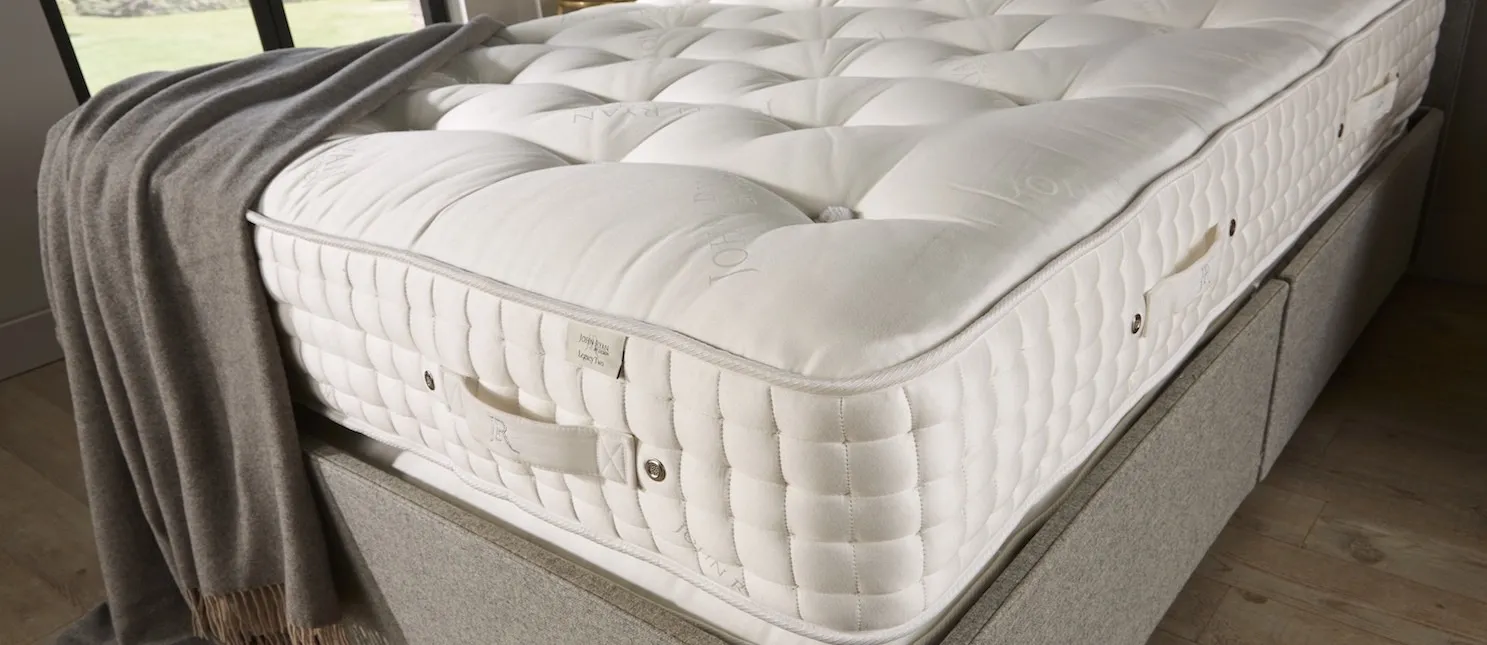
Given that one of our mattresses should last you well beyond the seven or so years a mass-produced one manages, with the right care and maintenance, a few weeks of getting used to it is a small price to pay.
What happens when you break in a new mattress?
Breaking in a new mattress is the time it takes for the fillings to relax and mould to you. It runs alongside your own adjustment period, which is why the two get muddled up.
With a handmade natural fibre mattress there’s a very physical reason it feels firm at first. Before we tuft a mattress, we squeeze it down on a compression rig, because an untufted mattress stands roughly 20 to 35% taller than its finished depth. So every layer of Wool, Cotton and Horsehair is packed tight when it arrives at your house.
Your weight, warmth and movement over the first few weeks let those fibres relax and settle around the tufts. That’s when the mattress starts to feel like yours. Different mattresses break in at different speeds, and as a rough guide from what we see and hear:
- Pocket sprung with natural fibres, like our Origins and Artisan ranges: two to four weeks for the fillings to settle, helped along by turning.
- Latex: one to two weeks, as Latex feels much the same from the first night.
- Hybrid spring and foam: four to six weeks.
- Memory foam: foam brands themselves quote 30 to 90 days, because the foam needs your body heat to soften.
If you run hot at night, that last point is worth a thought before you even get to the break-in. A mattress that needs your body heat to work is going to hold it against you.
Why does my new mattress feel uncomfortable?
John has had so many phone calls over the years from people saying that the first night on a new mattress was not what they were expecting, but you do need to give it time, both for the mattress to settle and for you to adjust.
When you ring us in the first couple of weeks, it’s nearly always one of four things. Here’s how we’d work through them with you.
It feels nothing like the one in the showroom
Most people spend less than two minutes on a showroom mattress, fully clothed, sometimes with their shoes on. That tells you very little about how it’ll feel at three in the morning.
The showroom model might also be a week old or three years old, with hundreds of people a day sitting, slouching and bouncing on it, and it’s very rarely turned. So of course your brand new one feels firmer. This is why we think trying a mattress in a showroom is close to meaningless.

Your body is still used to your old mattress
If you’ve slept in a dip for years, your body has learnt to sleep in it. A supportive new mattress holds your spine level, and that can feel odd for the first week or two.
This is the most common reason a new mattress feels uncomfortable, and it’s also the one that sorts itself out. If you’ve been undoing years of awkward sleeping positions on an old failing mattress, give yourself the time.
The base underneath has changed, or hasn’t
Put a new mattress on a tired old base and it’ll inherit every sag and wobble. Move from a sprung divan to a firm platform or slats and the same mattress will feel noticeably firmer.
Our mattresses need solid support or slats with gaps of no more than 7.5cm. If you’re not sure what you’ve got, our guide to bed bases explains the differences.
Your bedding is working against you
We’ve heard from people convinced their new mattress was making them overheat, only to find they’d also switched to polyester sheets that don’t breathe. A plastic-backed protector or a thick synthetic topper can change the feel and temperature of a mattress completely, so check what’s on top before you blame what’s underneath.
A new mattress is like a new pair of shoes…
Give it four to five weeks before you judge it.


New mattress too firm or feels too hard?
This is the one we get asked about most. A new mattress feeling too firm is completely normal in the first few weeks, and in most cases it’s the fillings still settling. What you need to work out is whether it’s the comfort layers that feel hard, or the springs underneath that are wrong for your weight.
Here’s the rule of thumb we use on the phone. If the top feels firm but you’re sinking in evenly and waking up without new aches, it’s settling and it will soften. If you feel like you’re lying on top of the mattress, with your shoulders and hips taking all the pressure, and that hasn’t changed by week four, the spring tension may be too firm for you.
Spring tension is chosen by body weight, and no amount of breaking in will change it. A light sleeper on a firm tension will always feel it pushing back. Our guide to soft, medium and firm mattress tensions has the full weight chart and covers how to soften a mattress that’s too firm, so we won’t repeat it all here.
If you’re sleeping on one of ours and it still feels too hard after a month, call us before you do anything else. We’d far sooner talk it through with you than see you spend money on a topper you don’t need.
How long does it take for a firm mattress to soften?
With natural fibres you’ll usually notice the biggest change somewhere between weeks two and four, as the Wool and Cotton relax around the tufts. After that the change is slow and steady over months.
Foam is different. It softens as it warms, which is why a firm foam mattress can feel harder on a cold winter night than it did in a warm shop.
What can you do while your new mattress breaks in?
There’s no magic trick, sadly. But there are a few things that help, and a couple that don’t.
Sleep on it every night
It sounds obvious, but a mattress you swap off after three bad nights, or one in the spare room, won’t break in. Regular use is what settles the fillings.
Use the whole mattress
Read, watch telly and sit on different parts of the bed, not just your usual side. On a king or super king the middle often never gets used, and that’s where a ridge forms later on.
Turn and rotate it after the first month
Turning and rotating spreads the settling evenly across both sides. We’d do it after the first month and then monthly, and there’s more on that further down.
Check the base and the room
Make sure your base is sound and level. Keep the bedroom at a comfortable temperature too; around 18°C suits most people and helps foam in particular.
Don’t jump or walk on it
We still hear of people trying to walk a mattress in. Please don’t! You can damage the springs and the tufting, and it won’t speed anything up.
Hold off on a topper
A topper on a brand new mattress hides the very thing you’re trying to judge. If after five weeks the spring tension is right and you’d simply like a softer feel, a natural Wool topper is the route we’d take.
Have I picked the wrong new mattress?
If you’re past five weeks and still uncomfortable, it’s worth checking whether the mattress was right for you in the first place. Our quick guide to selecting the best mattress for you walks through it, and it comes down to three things.
The spring tension needs to suit your weight. The comfort layers need to suit the feel you like. And you need to know exactly what the maker has put inside, down to the GSM of each fibre. If you can’t find that out, unfortunately you’re still guessing.
That last one catches a lot of people out. One customer told us the “natural fibre” mattress they’d been looking at from a leading retailer had just 250gsm of Wool, and the rest was polyester. Compare that with our Origins Comfort 1000, £890 in king size, with 1,000 pocket springs and 1,250gsm of fillings, or our best-selling Artisan Naturals, £2,180 in king size, with 1,600 pocket springs and 3,950gsm of fillings, 85% of them natural fibres. When you know what’s in a mattress, you know what to expect from it.
If you bought from a showroom, think back to whether the salesperson asked your weight. If they didn’t, that may well be your answer.
Making the most of your 60 day guarantee
Every standard size mattress we make comes with our 60 day Love It or Return It guarantee, so you’ve time to get past the adjustment period before you decide. Made-to-measure sizes are the exception, as they’re built for one bed. Other retailers’ return periods vary a lot, and plenty of bed-in-a-box brands offer an exchange window or a proportional refund, which isn’t the same thing, so read the small print.
During your first few weeks we’d suggest keeping a few notes:
- how you slept, and any new aches and where they are
- what time you went to bed and got up
- any new bedding, protector or topper
- when you turned and rotated the mattress
It sounds fussy, but when you ring us it means we can spot a pattern straight away. Quite often the notes show things improving week by week, and that’s reassuring in itself.
My new mattress smells. Is that normal?
Yes, a new smell is normal. Foam, polyester and other man-made materials tend to give off a stronger chemical smell for longer, known as off-gassing. If you’re sensitive to it, find out exactly what’s inside a mattress before you buy.
Natural fibre mattresses can have an earthy smell at first, which some people liken to the outdoors. That’s the Wool, and it fades. Open a window and leave the bedding off for a few hours during the first week and it’ll clear quicker.
When should I turn my new mattress?
We’d turn and rotate your new mattress after the first month, then every month after that. All mattresses settle at first, and turning spreads that settling across both sides so it stays even over the life of the mattress.

If you have a one-sided mattress, like most memory foam, you can only rotate it. We think one-sided mattresses have a considerably shorter life, and the so-called benefit of no-turn is marketing. Underneath there’s usually a bare spring unit or firm foam you’ll never sleep on, so when the top wears there’s nowhere else to go.
My new mattress has developed ridges
Some settlement starts as soon as you sleep on a new mattress, and it’s normal. If you skip turning, you may see a ridge form, usually down the middle of a bigger bed where no one sleeps. Our guide to settlement and indents in mattresses explains what’s normal and what isn’t.
On super king mattresses the middle can barely get used at all. That’s one reason we often suggest a zip and link model for bigger beds. It’s two mattresses zipped together, so it’s easier to turn and you’ll feel less of each other’s movement. Many of our models can also be made half medium and half firm if you and your partner need different tensions.
My new mattress is much thicker than expected
Our mattresses have considerably more fillings than the average retail model, so they’re deeper. The Origins range is 30 to 33cm (12 to 13in) deep and most of the Artisan range is 27 to 30cm (11 to 12in).
Standard fitted sheets won’t fit, so we advise everyone to buy extra deep ones before the mattress arrives. Our Extra Deep Fitted Pima Cotton Sheets are £55 in king size, and our 100% Cotton Quilted Mattress Protector is also £55 in king size, both made for deep mattresses.
It’s also worth checking your existing base or ottoman can take the extra weight, because we squeeze far more fillings into our beds than most. A king size Artisan Naturals weighs around 58kg, and many ottoman beds have a maximum mattress weight of around 60kg.
| Mattress Size | Origins Comfort | Origins Reflex | Origins 1500 | Origins Latex 1500 |
|---|---|---|---|---|
| Single | 23kg | 25kg | 28kg | 32kg |
| Double | 35kg | 37kg | 42kg | 48kg |
| King | 40kg | 44kg | 49kg | 56kg |
| Superking | NA | 51kg | 58kg | 67kg |
| Mattress Size | Artisan 1500 | Artisan Tailored Pocket | Artisan Naturals | Artisan Latex |
|---|---|---|---|---|
| Single | 28kg | 35kg | 33kg | 35kg |
| Double | 43kg | 52kg | 50kg | 57kg |
| King | 51kg | 62kg | 58kg | 65kg |
| Superking | 62kg | 74kg | 70kg | 78kg |
| Mattress Size | Artisan Bespoke 004 | Artisan Luxury | Artisan Bespoke | Artisan Bespoke 002 |
|---|---|---|---|---|
| Single | 35kg | 35kg | 39kg | 36kg |
| Double | 52kg | 52kg | 58kg | 54kg |
| King | 61kg | 58kg | 65kg | 63kg |
| Superking | 74kg | 74kg | 78kg | 75kg |
New mattress FAQs
Is it normal for a new mattress to feel uncomfortable?
Yes. Your mattress is still settling and your body is still adjusting from your old one. We’d give it four to five weeks before deciding it’s wrong.
How long does it take to get used to a new mattress?
Around four to five weeks for most people. Some feel at home within a few nights, but we’d always give it at least 30 nights before judging it.
Is it normal for a new mattress to be too firm?
Yes, especially with natural fibres, which arrive tightly packed and relax over the first few weeks. If you still feel pressure at your shoulders and hips after a month, the spring tension may be wrong for your weight.
Do mattresses get softer over time?
Yes. Natural fibre fillings relax and mould to you, with the biggest change in the first two to four weeks. The spring tension itself doesn’t change, so a mattress with the wrong tension won’t break in to the right one.
Should I put a mattress topper on a new mattress?
We’d wait. A topper hides how the mattress really feels while it’s breaking in. If after five weeks you’d like it a little softer and the tension is right, a natural Wool topper is a sensible option.
Should I use a mattress protector on a new mattress?
Yes, from day one. Choose a breathable Cotton one; a plastic-backed protector can make you overheat and change how the mattress feels.
What if I’m still uncomfortable after a month?
Get in touch with whoever you bought it from. If it’s one of ours, call us and we’ll talk through your weight, sleeping position and base to work out whether it’s still settling or something needs to change.
Summary
It’s completely normal for a brand new mattress to feel a little strange at first. Like a new pair of shoes, give it four to five weeks, sleep on it every night, turn it after the first month and check what’s underneath and on top before you blame the mattress itself.
If you’ve taken expert advice and chosen a mattress to suit your weight and your comfort layer preferences, you should be well on the way to your dream mattress. And if you’re a few weeks in and still not sure, give our small friendly team a call on 0161 437 4419 or drop us a message below. We’ll tell you straight whether it’s settling or something needs changing. Here’s to many years of good kip!

Dreaming of the perfect nights sleep?
Ask us a question
There are over 6000 questions and answers submitted by you on all questions about mattresses and bed problems. Enter a keyword such as Vi Spring, John Lewis beds, bad back or Memory Foam and see if your question has already been answered.
If you can’t find an answer in knowledge hub, ask a new question. We aim to respond to all questions within one working day.
Newsletter
Enter your email to join our newsletter. We’ll send you occasional news and mattress expertise.